
Reform’s recent local electoral victories should be a further wake up call for the social change sector to respond to the threat of the far right. Because NGOs appear to be struggling to shift strategy (to the extent and speed required to meet the moment – as outlined in our previous report), Jim Coe and I have produced Towards Meaningful Action – a new piece of research (drawing on a survey and focus group) exploring how NGOs are impacted, how they are responding, what the blockages to a significant strategic response are, and how these might be overcome.
You can download the Towards Meaningful Action full report here.
I summarise some of the findings below and we are also hosting an online launch event on Wednesday 20th May.
Elements of the problem are interconnected
It’s clear the far right and its ideas are further gaining ground in the UK; in elections, on the streets, in public narratives, and in hearts and minds, normalising racism and xenophobia. Although it’s certainly a cause for celebration that ‘Unite the Kingdom’ 2 at the weekend attracted a much smaller crowd than last years’, this doesn’t mean the threat is going away. As the far right gains visibility and power it grows bolder, and the cycle continues. The problem is a complex one, because these elements are intertwined, but their impacts hit differently.
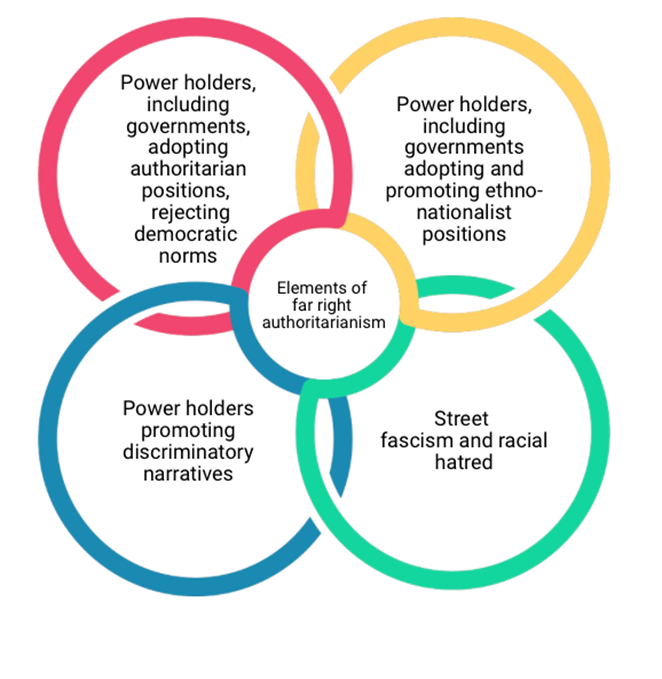
As I’ve written previously, the political side of the problem is not just the threat of Reform winning Westminster, or the impact of Reform’s growing institutional power in other levels of government. We are also seeing mainstreaming of both far right (particularly anti migrant and anti trans) and authoritarian (like protest crack downs, threats to jury trials) policies adopted by the incumbent Labour government – although Reform’s would no doubt go much further.
All this should be even more of a wake up call to the nature of the threat the social change sector faces. While we are seeing increasing action, much more is needed.
The context is having substantial negative impacts on NGO’s & communities
Around 3/4 of those surveyed reported ‘very significant negative effects’ or ‘some serious negative effects’ to organisations missions and to communities. We’re seeing similar results from other research including the SMK Campaigners’ survey and from NCVO’s feedback from its members.
A range of issues impacted in our survey included migration and trans/non-binary justice, climate policy, housing, human rights, global conflict, social cohesion and end-of-life care.
Safety, security and well being of staff and communities were highlighted by many in the survey, including reports of attacks and verbal hate crimes, as well as the threat of violence. Other reported negative impacts included:
- Increasing racism and Islamophobia
- Mission impacts of the rightward shift of discourse & policy
- Fallouts from the hostile media environment, especially online
- Space for people, groups and organisations to participate in shaping society is shrinking
There’s an existential threat – but organisations are feeling this differently
Impacts of far right authoritarianism hit NGOs differently, according to the following variables:
| How much issue(s) an NGO works on & communities worked with, are currently under attack | Work on issues / with communities at the forefront of attack (e.g. migration justice, trans rights & increasingly climate change) are better attuned to the threat than those currently unaffected, or more tangentially impacted. |
| Approaches to making change | Organisations that campaign and/or invest in organising are, and will be, affected differently to those who focus solely on service delivery. Those operating to a rights-based approach will have a different experience to those applying more of a charity lens. |
| Charitable status | For those that are charities, beliefs about the limitations arising from Charity Law are a damper, but not a blockage, to action. |
| Positions of supporters & communities an NGO works with | Some NGOs are reporting their communities and supporters have been radicalised by / are increasingly sypmathetic to, the analysis of the far right |
| Organisation size | Survey results suggest that larger NGOs may be less well equipped to respond meaningfully, as they are hampered by higher levels of internal disagreement and strategic uncertainty. |
| Specific political contexts | As the number of Reform-led councils and authorities grows, effects and choices are becoming more present for some, for reasons including implications for securing statutory funding. |
| International, national, and/or locally rooted | International organisations may be more aware of threats (when working in other countries already impacted) but this doesn’t necessarily translate into greater responsiveness. Many national organisations are less connected to local communities, and so are feeling the effects less urgently, and less viscerally. |
There are calls for more funding – but how & where this goes matters
As ever, funding was widely reported as a blockage to action. But rather than more reports saying that funders need to step up, what we actually need is more funders meaningfully responding! I know many are increasingly taking the threat seriously (with much gratitude to Civic Power Fund, Ariadne & others who have been encouraging engagement with the scale of the threat).
Interestingly, survey results showed that larger organisations are not doing more in response than smaller ones – as noted by the number of ways they reported currently responding and the ways in which they planned to. This may be accounted for by those organisations heaving greater internal complexity, as they also reported higher levels of internal disagreement and strategic confusion.
Larger funders (philanthropic, wealthy individuals and others) are often looking to move more significant chunks of money at once, and often aren’t set up to manage the admin of giving out multiple smaller grants. Unfortunately this means the recipients of such funds are more likely to be larger institutions that can handle big grants – who (according to our survey) are less well placed to respond, and in fact are responding less, to current threats.
I think this warrants consideration of more and new pooled funding to support strategic responses to the authoritarian far right – to be reactive and manage grant admin to smaller entities, while having an eye on the overall funding ecoosystem and the gaps. This could usefully contribute to the Solidarity Fund initiated Civic Power Fund and Migration Exchange (addressing security and resilience, especially for the migration sector), and build on their leadership with a further pooled fund to build power and push back. Money is also needed for relational infrastructure to facilitate cross sector collaboration, and build the relationships that underpin this.
Cultures of timidity & reticence are holding organisations back
In the survey, organisations almost universally said they thought they should be taking the threat of the authoritarian far right seriously, but this wasn’t nearly as universally matched by action. According to the survey, the notion that “the best way to avoid being dragged into ‘culture wars’ is to stay out of them” features to some extent in most internal discussions.
“There is nervousness within the organisation & our network about making clear assertions about the threat of the far right.”
“A culture that prioritizes comfort over conflict holds us back from doing better both internally and externally.”
This is in many ways unsurprising – organisations are afraid of becoming targets. As Scot Nakagawa writes, fear is the fulcrum of authoritarianism itself. But organisations cannot immunise themselves from attacks by keeping their heads down – and this behaviour does nothing to counter current trends. We need more bravery, and solidarity is the best remedy for fear. If we act together we are stronger, always.
What do steps towards meaningful action look like?
We have been repeatedly asked for simple steps to counter the threat, or ‘the most important 3 things organisations can do’. Unfortunately, because of the complexity of the issue and the different types of organisations we have surveyed, there is no ‘one size fits all’ approach we can recommend.
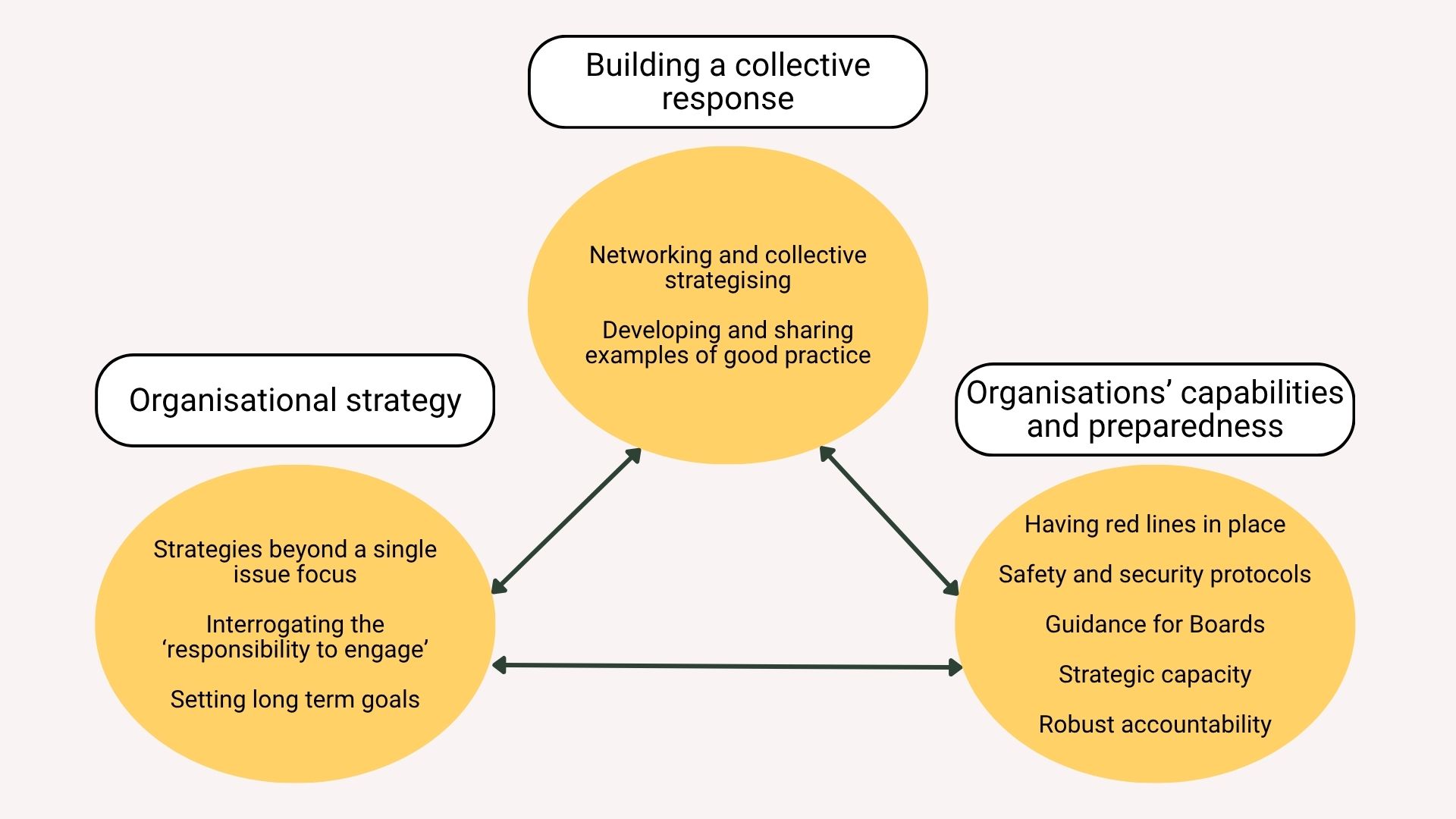
But the survey and roundtable do point to a set of things that can help NGOs at different stages on the journey towards meaningful action, and these can be grouped into considerations for organisational strategy, organisational capabilities and preparedness, and building a collective response (thanks to Jim for the diagram):
Jim’s additional diagram shows how this might work in practice according to the stage your organisation is at with its response and needs:
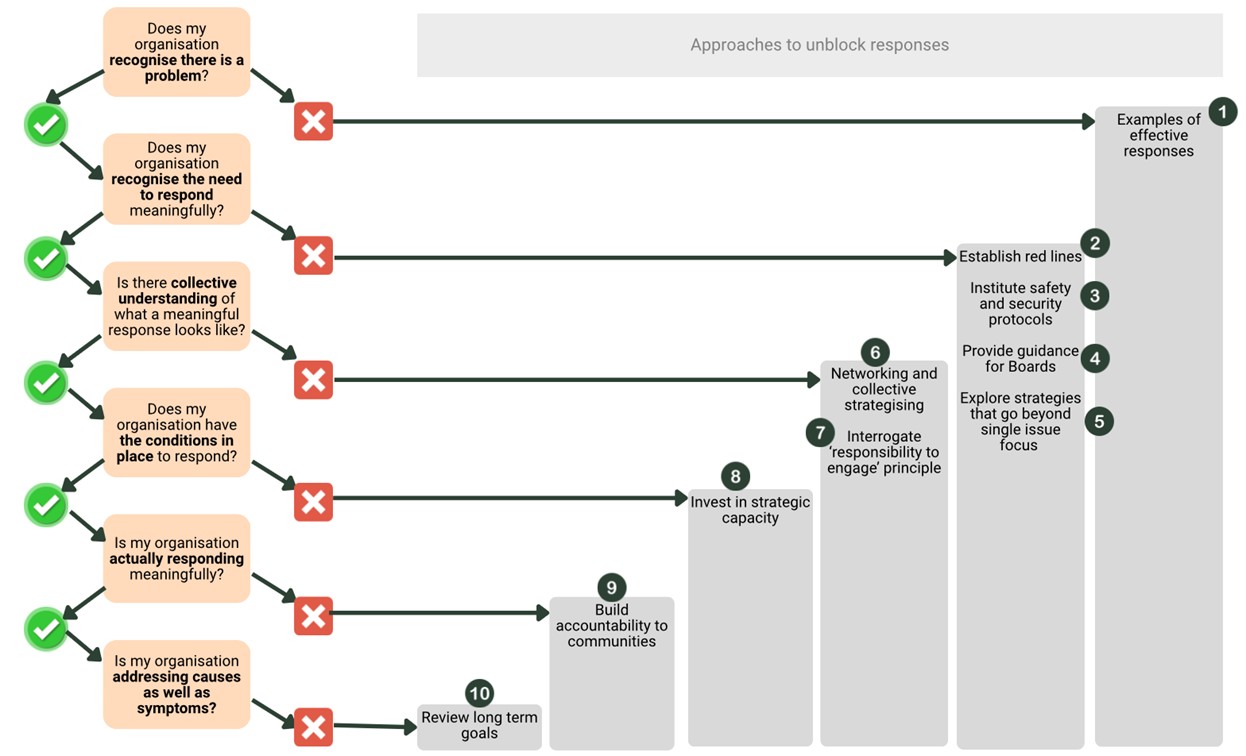
1) Examples of good practice to help guide action are needed
There were various requests for more guidance and case studies on what a good response would look like, and having examples to build from, as well as other support, including around legal advice and narratives. It will be important for organisations that are responding to share their thinking and practice with peers, ideally including examples from different contexts, including learning from experiences in other countries.
What is already happening?
International democracy defenders D-Hub have just launched their anti-authoritarian toolkit, filled with examples of successful tactics and strategies used to oppose authoritarianism and promote democracy around the world.
2) Clear red lines are needed
Less than half of organisations surveyed have clear red lines in place to draw on in deciding how best to navigate current or future threats – such as positions on when / how /if to engage with decision makers, being clear what anti-racist policies and commitments to EDI mean in practice. When faced with real time threats, it’s better to be navigating ambiguity about how to adhere to a set of established principles than to be confused about what those principles should be. In the US we’re seeing that organisations are much more likely to fold in response to actual, perceived or anticipated pressure if clear positions aren’t pre-established.
What is already happening?
Letesia Gibson’s article ‘Beyond Engage or Not’ is worth reading, and her organisation New Ways has been offering a strategy clinic supporting leaders to think through navigating when and how to engage with decision makers in alignment with anti-racist and EDI commitments.
3) Safety and security protocols
Survey findings make clear that security and safety are currently significant issues, but 1/4 organisations don’t have safety protocols in place and aren’t planning to develop them. This seems risky given the current situation and possible futures. There is much to consider here for safety and security of communities, staff and organisations in the frontline, including impacts on staff capacity through burnout, erosion of staff morale, and increased financial burden as set out in Beyond the Emergency by Li-En Yapp writing for Migration Exchange.
These obligations extend to all organisations to protect staff, trustees and volunteers who are at increased risk such as visibly queer people, people of colour, Muslims and Jews – this argument is eloquently made in Your Board Has a Duty of Care by Anj Handa.
What is already happening?
– Common Knowledge has a Community Security Leadership Development Programme in development, website launching soon.
– Civic Power Fund have collated this list of useful resources for community security and resilience
– The Tactical Tech Holistic Security manual provides excellent guidance to take a holistic approach to strategy in this space. NGOs that have significant safety/security capacity will need to continue to be proactive in sharing their policies and practices with others.
4) Guidance for Boards
1/3 survey respondents did not agree that their Board was taking the threat seriously – rising to more than half for the biggest NGOs. This indicates a gap between Boards and staff in terms of how seriously the threat is being taken, suggesting a continuing need to help Boards navigate the situation we are now in, for example by highlighting the strategic implications of the current context and exploring the risks of inaction versus action.
What is already happening?
As far as we’re aware there are no existing resources or projects addressing this issue. It would be useful to develop some work in this area, and for Boards taking meaningful strategic responses to offer peer support and to share their experience and thinking. Sharing Andrew Purkis’ analysis what the Reform Party means for charities may be a useful starting point.
5) Strategies beyond a single-issue focus
More than two thirds of survey respondents from the biggest organisations agreed (or strongly agreed) that there is internal strategic confusion about how best to respond. Given this, there seems to be a tendency to carry on with traditional approaches, because that’s how organisations are structured and where the investments have always been, and in the absence of clear alternative directions.
“[We need] a more sophisticated understanding of campaigning and advocacy.“
“We need … a coherent and focused strategy that enables us to campaign on issues of importance while also focusing on the existential threat.“
As identified in ‘Meeting the Moment’, traditional approaches (campaigning and advocacy focused on incremental policy progress on single issues) are decreasingly effective. The challenges we are facing aren’t going to be overcome on an issue-by-issue basis because they are bigger than that. As movement actors learnt from their experiences in Hungary:
Too much social justice infrastructure is locked into well-meaning programs to advance specific issues and policies. But these are no ordinary times.
5 Lessons from Hungary – Gordon Whitman
To effectively confront movements and regimes that aim to break democracy and dominate institutions, we need to devote more resources and energy to building cross-issue and cross-constituency coalitions [with] a focus beyond specific issues to the larger struggle to protect and expand democracy and advance a vision of society that makes sense to regular people.
What is already happening?
As far as we’re aware, there are no existing resources or projects addressing this issue. Work to develop ideas about strategic options for (current and) future advocacy and campaigning would be useful. This also means addressing the incentives – including from funders – to continue to replicate existing practices.
6) Networking and collective strategising
Survey responses show strong interest in collaboration and partnership working – including through coordinated and joint action. Several flagged the importance of practical solidarity, and the need for external encouragement (coaching, peer influence), with some citing the need for greater pan-sector leadership.
There are many benefits from people coming together to explore their situations and learn from others, including relationship building, inspiration, practical collaboration and active solidarity, improved collective strategic insight, resilience and emotional support.
What is already happening?
– There are a variety of externally focused cross issue coalition initiatives making specific interventions (such as A Million Acts of Hope and the Together Alliance), and projects underway to convene inside issues / sectors (such as climate and nature, migration, human rights, unions and arts organisations).
– Because more is needed, co-author of this paper Natasha Adams is fundraising for a project to build relationships and facilitate further collaborative action, and has started to host a network of existing convenors to connect different initiatives in the space.
7) Questioning the ‘responsibility to engage’
Over half of survey respondents (3/4 of those in the biggest organisations) said the responsibility to engage with all decision makers is a view that ‘dominates’ or ‘tends to prevail’ in their organisations.
“There is … a culture of fear of being seen as party political if we don’t work with far-right political actors in the same way we’ve worked with more ‘mainstream’ parties in the past.“
What is already happening?
– It is important that positions that NGOs come to on this are well considered and not simply arrived at by default. This means being clear about the difference between being non-partisan and apolitical. For example, it is acceptable for charities to highlight policies and positions (including of specific political parties) which are directly at odds with their charitable objects.
– Law firm Bates-Wells produces regular legal updates for charities.
8) Increasing adaptive strategic capacity
Put simply, what we mean by strategic capacity is that organisations have:
- good intelligence,
- good decision-making capabilities in response to that intelligence, and
- the ability to adapt accordingly and promptly.
According to our survey larger organisations have better intelligence but are comparatively less effective in acting on it. But still most agreed that “My organisation is good at actually adapting its strategic approach in response to change” even within the biggest NGOs. This was surprising to us, as our own interpretation of NGOs’ capacities – and incapacities – to respond doesn’t fully align with this picture. However, it’s relevant too that fewer than one in five of the respondents from the biggest NGOs agreed that “My organisation is good at making hard choices between competing priorities”.
This is the current challenge facing many NGOs: a need to go beyond ‘business as usual’ and adapt to a radically different context in a time of increased demand with constrained income, financial crises, restructures and redundancies.
Building strategic capacity should be universal goal, to meet the moment. More work is needed to support organisations to ensure they are taking on appropriate levels of trustworthy information (avoiding overwhelm), and that their structures, cultures and practices facilitate timely decision making and adaptation in response.
What is already happening?
– Co-author of this paper Jim Coe has developed a tool to support strategic discussions around potential future scenarios.
– Civic Power Fund and allies recently convened philanthropic funders in a large-scale scenario planning exercise. More use of this approach is needed to encourage wider action, e.g. by situating organisations 18 months into a Reform government, exploring the potnetial impacts, then looking back to consider what they wish they would have done earlier.
– We don’t know of any projects focused on producing guidance and support to develop strategic capacity, but this article by Dr John Renouf on navigating uncertainty may be useful.
9) Accountability flows to affected communities
There can be pitfalls in relying on internal judgements about the effectiveness of your own responses. A recent survey of foundations in the US, for example, looking at how foundations have stepped up to the address the context there, found that:
“While 93 percent of foundation leaders believe their foundation has been effective in understanding the challenges their grantees are facing, only half of nonprofits report their funders have been effective in this way.“
It is important for NGOs to draw on the experiences and insights of the grassroots organisations and communities they work to ensure they are working effectively. This means having strong accountability mechanisms, and being clear about the directions in which accountability flows – addressing contradictions arising from accountability upwards to a Board, or to power holders, versus down to a base. These things aren’t always in place within NGOs. As one survey respondent commented:
“Leadership is far too embedded in the political status quo while at the same time not being effectively accountable to people with lived experience we’re supposed to represent.“
What is already happening?
– Although there are (and have been) efforts at establishing some ‘lived experience’ leadership, through advisory panels, roles on Boards, commissioned research and more, we are not aware of significant efforts to shift accountability meaningfully towards communities or grassroots organisations (outside of organising projects and organisations set up this way from the start).
– Potentially useful references include the Collecting our Dues report from Act Build Change and Love and Power (which makes the argument for finance from membership to bake in accountability to a base) and the Grassroots Charter from the Global Grassroots Support Network (setting out what is needed to ensure equitable relationships between NGOs/funders and grassroots groups) – as well as our own previous work exploring if grassroots groups can partner with NGOs.
10) Addressing root causes through long term goals
The survey results reveal widespread concern about the threats from mis- and disinformation and hostile communication environments. But this is not matched by the extent of the actual or planned focus on working to re-balance the media eco-system and communications environment, or on the future resilience of democratic institutions.
These areas are more difficult to fit with mission and mandate, less immediate a concern, and less obviously solvable than some other things. But unless there is collectively greater attention to addressing the deeper causes of the threat – as well as the threat itself, and its effects – then we will end up stuck in a toxic holding pattern.
What is already happening?
– We are aware of some initiatives developing in this space (for example around the rule of law / democratic resilience, and the growing threats of billionaire / ‘bro-ligarchical’ tech), but more work and attention is needed to address longer term root causes.
– The relational infrastructure project co-author Natasha Adams is working to establish would have a focus on convening around 2-3 gaps like this to encourage and incubate new collaborate projects to fill them, and has a planned focus on undermining the power bases of bad actors.
As ever, I’d love to hear what you think about this? Is your organisation doing some gratef strategic work you’d like to share? Please comment below or via Linked In to join the conversation
If you’ve enjoyed my writing and would like to support me to create and share more, or to continue my work on the far right, you can buy me a coffee. I share my work for the love, in the hope that its useful to strengthen movements, and that’s the biggest reward. But I’ve been working a lot unpaid on far right stuff, trying to fit it in around freelance work, so more donations would enable me to give it more time. If you feel moved to donate something (no pressure at all) it would be gratefully received


