I’ve been sounding the alarm about the existential threats of the geopolitical moment and the need for much more action for a while… To balance this, I wanted to share some of the incredible projects I’m inspired by. There are many excellent initiatives of all sorts that are pushing back against far right authoritarianism on multiple fronts. It’s worth celebrating that.
Whether you’re just someone worried about the far right, an organiser, funder, campaigner or working elsewhere in the social change sector, I hope you’ll find a project to support or get involved with, and plenty to inspire you below.
An important caveat
When I originally started writing about the growing power of the far right and what the social change sector can do about it, I was worried that publishing any sort of a mapping would be a huge admin effort, as I’d need to get every organisation I mentioned to sign off on anything I said about them (to ensure it was accurate and used the kind of language they were comfortable with). I haven’t done this, but I want to be clear that I am not saying all the organisations below are consciously pushing back on the authoritarian far right.
Many wouldn’t frame, or even understand, their work in this way. And the language I’ve used isn’t necessarily exactly the way they would talk about what they do – I’ve described their work using my own words. What I am saying is that I think all the work below has an important role to play as part of a change making ecosystem to push back on the authoritarian far right, in multiple ways, to address the different threats and challenges it poses. Of course the work below does lots of other good stuff as well!
The last thing to note is that this list isn’t exhaustive. There are many good things I’ve just not had space to mention, and things in the works that are not public yet, or happening below the radar. If I haven’t mentioned your project and you’d like to share it, please feel free to leave a comment with some info and a link. Heartfelt thanks to everyone already deep into this work. And to those considering how to get involved, from an organisational, donor or personal perspective, I want to encourage you to step up as much and as quickly as you can.
I have used categories from the Meeting the Moment report to structure the writing.
Building narrative power
A million acts of hope
A project initiated by Hope Not Hate and supported by over 100 charities and community groups. It will coordinate a week of action from the 13-20 May (to coincide with the next ‘Unite the Kingdom’ far right march planned in central London on May 16th) with events all over the country celebrating positive local activities.
These events might be focused around collecting messages of hope, celebrating local community with a picnic in a park, or anything that centres the quiet, caring transformational work happening all the time (like children’s sports events, food bank volunteering and community gardening).
You can get involved as an organisational partner, a community group or an individual. This isn’t the kind of strategic communications work commonly thought of as narrative work, but it centres local messengers and local messages alongside cultivating belonging, which could be very powerful.
Common Ground
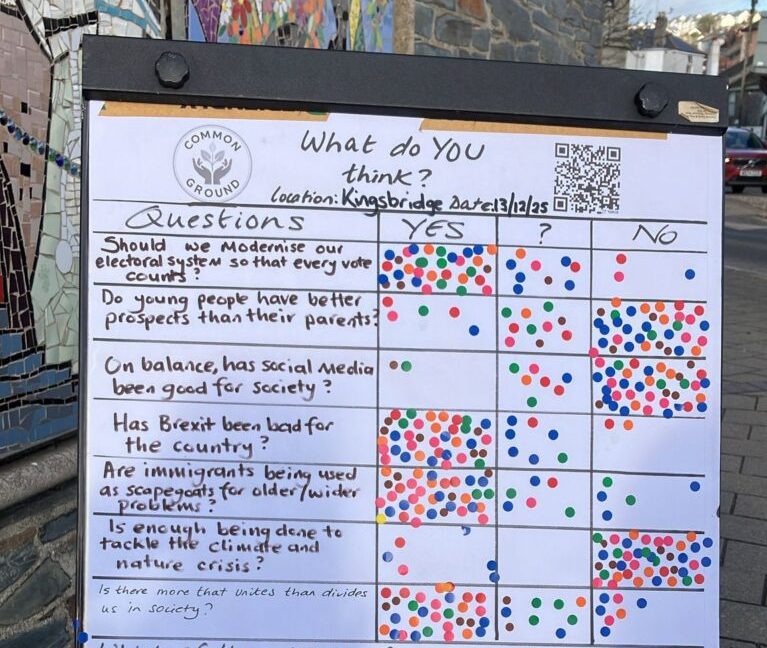
This is very different kind of project, developed by people who had been involved in the South Devon Primary which created a progressive voting block locally in the last general election. Volunteers take to the local high street with questions written up on a flip chart stand and a supply of sticky dots, and they ask passers by to place a dot against their response to topical issues – the scapegoating of migrants, the prospects of younger people, Brexit and climate change (see the picture below for an example). Then if people are up for sharing more about their thoughts, they start by listening, centring kindness and compassion.
This approach means people are more likely people to listen in response if volunteers running the project gently correct disinformation, or share a different perspective. Author Anthea Lawson has written about her experience of being involved on her Substack – How Not to Change the World.
Working towards a fair media ecosystem
Public Interest News Foundation (PINF)
This is the UK’s first and only charity working to regenerate local news. Local journalism connects communities, strengthens democracy and offers an important antidote to the mis and disinformation peddled through big tech platforms. But the local news ecosystem is a mess, with hundreds of local newsrooms and thousands of journalists lost as advertising revenue has evaporated.
This means often people live in ‘news deserts’, without local journalists holding local councils or businesses to account, meaning residents are forced to seek local news from unreliable and often biased sources like Reddit threads and Facebook groups. The PINF advocates for more funding in this space and manages its own local news fund, campaigns for local news, produces research on the state of the ecosystem and spotlights new approaches to journalism.
Stop Funding Hate
This campaign focuses on making hate unprofitable by persuading advertisers to pull their support from publications that spread hate and division. It started ten years ago in 2016, a year with an unprecedented number of negative headlines about migrants and refugees in the Daily Mail, Sun and Daily Express. The campaign makes a connection between hate speech directed at groups like Muslims, people who have migrated, refugees, the LGBTQI community etc, and a rise in hate crime targeted at these communities. They direct public pressure to businesses who advertise in news outlets running hateful headlines. Major advertisers like Lego and Bodyshop have changed their advertising practice as a consequence.
Investing in deep organising
AWETHU school of organising
The project takes its name from the anti-apartheid chant “AMANDLA AWETHU,” meaning “The power is ours.” It is a transformative educational project that offers training to the black community in political education and grassroots organising. It was established to address the lack of political education in movement spaces and the prevalent culture of merely “reading the right books” without translating knowledge into action.
They’ve run two cohorts, taking them through an eight week programme, in 2024 and 2025. Their website days that details to apply for the 2026 cohort will be live soon, so sign up to their mailing list (link above) if you might be interested.
Right to Remain
This is an organisation whose impact far outweighs its public profile. They produce accessible resources and deliver community training, which enables people to navigate the legal maze of the UK asylum and immigration system and take practical action in their legal cases. Their best known resource is the Right to Remain Toolkit – a guide to the asylum and immigration system.
Alongside this they have strong focus on building practical solidarity between migrant groups, led by and centring those at the sharp end of the migration system, bringing communities together to share their struggles, expertise and learning. They run These Walls Must Fall, a network of refugee and migrant campaigners working with allies and supporters for radical change, to counter the government’s racist hostile environment and fight for an alternative. They’re one of the organisations I personally support – if you’re like to, you can donate to them here.
Building social and racial justice solidarity networks
ARM (Anti-Racist Movement)
Black Lives Matter UK has collaborated with Right to Remain (see above), Migrants Organise and Maslaha to launch ARM – an interconnected network of anti-racist activists across the UK, aiming to build a radically democratic, multicultural society free from racial oppression and exploitation. Since launching at the end of October 2025, groups have formed across the country (including south London where I live).
The network will focus on relief to build trust through mutual aid, repair to build solidarity through collective action, and ultimately on restructure at the level of democracy and society itself. It’s an ambitious project started on a shoestring but with some smart strategy, serious momentum, and solid organisations behind it. You can sign up here if you’re interested in getting involved.
ARC’s work focuses on unpacking class and redistributing wealth. They bring together mixed class groups in two day long workshops to share class experiences, interrogate the ways in which participants have internalised class hierarchy, and to set up local wealth redistribution projects. By the end of 2025 these projects had directly redistributed £529,000. They’re working to expand their facilitation pool, run more local workshops and take their work to a much wider group of people online.
One of ARC’s founders (and author of Chav Solidarity) D Hunter writes an excellent substack (separate to ARC but I thought worth a mention here). There he talks, amongst others things, about his experience organising with ‘the estate left’ which he describes as taking its abandonment as a starting point, not a grievance. For anyone interested in class and organising, I think this is essential reading.
We want… People who want to unpack the damage that capitalism has done to their minds, and resource the communities of resistance they are connected to.
ARC’s article on Organising Beyond the Middle Class Echo Chamber
We want to ask ourselves deeper questions about what it means to work in solidarity cross-class against the ruling class.
Undermining the power bases of bad actors
Everyone Hates Elon
I love this campaign group. They’re taking brave action against the billionaires and elites through funny, clever angry visual stunts shared through striking images, often getting picked up by global media and circulated widely online. You might not have known iwho was behind it but I’m sure you’ll have seen their work. They got Amazon boss Jeff Bezos to move his wedding after unfurling a giant banner which read ‘if you can afford to rent Venice for your wedding you can afford to pay more tax’ – this image went everywhere. More recently, after Monaco based Manchester United Owner Jim Radcliffe said immigrants were ‘colonising’ the UK, they put up the billboard below outside the Old Trafford stadium (he was eventually forced to apologise).
Jeff Besos has been appointed as the chair of this years’ celebrity studded Met Gala. Because Jeff is “one of Trump’s billionaire supporters” & “Amazon helps ICE and forces workers into poverty” they’re fundraising to ruin it for him. You can chuck them some cash here – I’m confident they’ll use it well.

Protecting civic space
Speak out
In the face of all the obstructions to civic space in the UK, from the Lobbying Act to the Proscription of Palestine Action as a terrorist group and everything in between, Speak Out is the only live project agitating for a the social justice sector to push back. It hosted ‘Don’t be Silenced‘, a conference at Friends House in January this year which gathered more than 100 people to think together about how we face up to the threat to our campaigning rights, and build the power we need to protect and enhance civic space. There are plans afoot for next steps – to be kept updated on all happenings in this area and hear about future events you can sign up to the Speak Out newsletter.
Robustly & visibly opposing the far right
Together Alliance
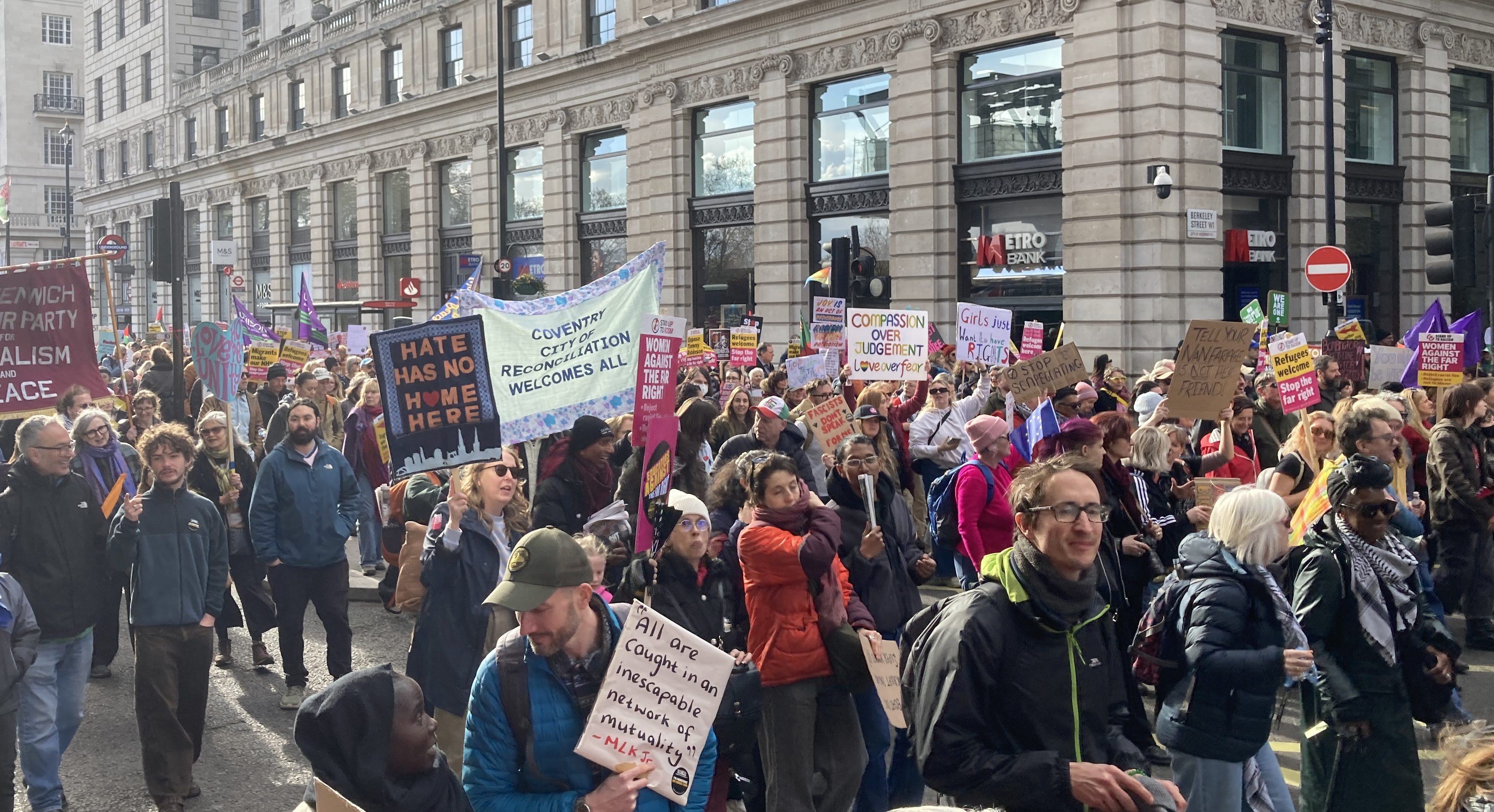
This was the progressive movements’ alternative to Tommy Robinson’s ‘Unite the Kingdom’ march – another huge march to mobilise “for love, hope and unity in the face of hate, fear and division, and raising our voices to stop the rise of the far-right.” It was organised by a coalition of hundreds of civil society organisations (including multiple unions and campaigning organisations like Friends of the Earth and Praxis). March 28th saw around half a million gather in London to share messages of solidarity and peace.
I know the police apparently estimated there were only around 50k there, but having been on many protests over the years (and very alive to the desire for organisers to exaggerate numbers) I’m pretty sure it was around half a million. It took my friends and I four hours to get from Park Lane to Trafalgar square as there were so many people. There was a good atmosphere, lots of music, dancing and chants, lots of home made banners centring hope, love and togetherness. I’m not sure what they’re planning next but the Alliance’s website is urging people to register to vote and to get organising in their communities.
“We are trade unionists and environmentalists, community activists and faith leaders, musicians, athletes, entertainers and elected representatives. And we’re marching together to show our neighbours that we’ve got their backs.“

Influencing mainstream politics
Verdant
In Meeting the Moment, and in general, I’m not advocating for more energy being put into influencing mainstream politics. It’s not that I don’t think its important – it’s more that there is decreasing power behind the tactics that have been used to exert influence over the last couple of decades, so traditional lobbying, advocacy and policy work isn’t getting traction. Despite this, there is still a huge amount of energy being poured into work with very limited returns.
BUT given the meteoric rise of the Green Party under Polanski’s leadership, I think the launch of Verdant, a new think tank focused on influencing the Greens, is timely and interesting. It is headed up by Economist James Meadway and author/ NGO leader Deborah Doane. In their first report, they “identify, conservatively, over £30 billion in potential annual savings: not from cutting public services, but from tackling the real waste in how government procures goods, fights fraud, and collects tax.” They’ve got a serious and capable board including ex Green MP Caroline Lucas and it looks like they may well have the ear of their target party.
Doing electoral work
Green New Deal Rising (GNDR)
This is a youth campaigning organisation focused on climate and economic justice. It uses tactics of targeted disruption and smart electoral organising. They’re currently busy coordinating the latter through My Election Map, highlighting canvassing opportunities to door knock for progressive parties that are well placed to beat Reform UK in the May elections.
Founders Hannah Martin and Fatima Ibrahim write a substack called Change the Weather where they’ve been sharing their reflections and learning, including being candid about what hasn’t worked. They are starting a community of practice which they hope will be: “a space for organisations that are serious about engaging in electoralism to share learning, test approaches, and build the strategic and delivery muscle needed to engage in electoral work together.”
Safety, security and resilience
While I know there are some promising new projects in development in this space (some funded and others seeking funding), its early days and I’m not able to publicly share details. The need is high, especially for communities of colour, people who have migrated, organisations that support them and other marginalised groups. Much more is needed to ensure our communities, and organisations, are safe from threats, abuse and violence. BUT I’ve been encouraged to see some funders stepping up (and hope these efforts will increase).
Instead of an organisation, group or project I want to share here a list of useful resources put together by Civic Power Fund. There’s loads in there, from physical, digital and community safety to legal rights, narrative frameworks, crisis communications guidance and more. Please share with anyone you think could make use of it.
Building relational infrastructure
The baseline category in the ‘Meeting the Moment‘ report is re-orienting strategy and resources. As well as protecting our people and movement spaces, action here fundamental to getting the kind of ecosystem wide action going that is needed. Much of what we’re doing isn’t working, so we need to try new things, learn quickly, and build our power.
There are a variety of convenings and collaborations happening in different movement spaces, but these remain in issue, specialism or theory of change siloes, and many are connecting with me (and other freelancers) to get a sense of wider action. Nothing yet exists to connect these things together so that they can build relational power and be more than the sum of their parts. I’ve been doing the work of building relational infrastructure in an ad hoc way so far – with the Slack group (300 strong now) and requests every week for 1:1s to discuss strategy in the face of what is happening from all over the sector (including funders and NGOs), invitations to speak etc. I’m doing a lot of this unpaid, which isn’t sustainable, but it would be much better in all ways to build a networked structure to hold relationships and facilitate a more dispersed information sharing network. So that’s what I’m trying to do…
I’m fundraising to build a relational infrastructure project
I have a costed proposal for the first year of work, to iterate and learn as it moves. It will focus on:
1) Building trusted relationships through on and offline convening and network architecture, incubating collective action in strategic areas with least current activity.
For example, this would involve convening ‘circles’ of interest in areas such as replicable place based approaches bringing communities together to take action, new work to build mass campaigning to undermine the power bases of bad actors, and direct work on protecting civic space in connection with the Speak Out project linked above)
2) Facilitating information sharing and learning by hosting an online library to make existing resources and events easily accessible, develop new ones, and disseminate widely. An organisation has already offered to host this library.
3) Maintaining an ecosystem view of UK social change responses to the far right, supporting connections across and beyond it, so that gaps can be identified and filled, and actors with mutual interests can be connected.
Some funders are actively considering supporting this project the need is pressing but I’m keen to get going. It’s already set up with a fiscal host, and I am grateful for the small contributions which have covered some of my time to continue this work (including a piece of research into how NGOs are strategically responding and what any barriers might be with Jim Coe – more on this later in the month). If you’re interested in contributing I would welcome a conversation and be happy to share my proposal.
Mailing list really is coming soon
Apologies to everyone who signed up to the general email list for the relational infrastructure project – I will set up a CRM for this and an email list for my own work very soon. If anyone is interested in joining you can sign up through this secure form.
As ever, I’d love to hear what you think about this? Do you have a project you’re involved with you’d like to share? Please comment below or via Linked In to join the conversation
If you’ve enjoyed my writing and would like to support me to create and share more, or to continue my work on the far right, you can buy me a coffee. I share my work for the love, in the hope that its useful to strengthen movements, and that’s the biggest reward. But if you feel moved to donate something (no pressure at all) it would be gratefully received

 thinking, doing, changing