
We need new strategies for social movements to respond to the rise of the authoritarian far right in the UK. We’ve just seen a fresh round of racist riots targeting asylum hotels, and far right extremists have inspired people to fly and graffiti St George’s Crosses everywhere in ‘operation raise the colours‘ resulting in Keir Starmer expressing his ‘support for flags’.
As I draft this Reform UK are meeting for their conference in Birmingham, and I’ve heard that some civil society organisations are (bafflingly) planning to attend. A Reform focused UK think tank has just announced “plans to examine ways to weaken the authority of Britain’s judiciary and civil service under a future right-wing government, and make Trump-style sweeping changes to UK law” – their anti-democratic intentions couldn’t be clearer.
We don’t have any easy solutions, but on July 16th Jim Coe and I hosted an online workshop with 42 change makers from across civil society. The reflection below summarises some of our discussion and thinking, and suggests some potential next steps. We’re also hosting another online workshop to talk about this on October 9th – you can find more information and book a place here.
What’s the problem?
This is articulated at length in my previous writing, but in essence we’re talking about Reform UK, their sweeping wins in the May council elections, their polling popularity and general traction, in the context of a greater global hegemonic shift towards authoritarian far right control. We need only look at countries like India, Hungary and the United States to see where this trend is headed, and indeed these forces are already deeply affecting our politics, shrinking civic and democratic space by the day.
What aspects of far right authoritarianism are most concerning to our movements?
We asked the 40+ people registered for our online workshop what they were most worried about. Causes and issues mentioned included the rise of racism, xenophobia and anti-migrant feeling, NHS privatisation, the dismantling of the welfare state, the threat to net zero policies and the rise of climate scepticism, as well as broader threats to human rights and social justice.
Wider than this, many people expressed concern about restrictions on civic space to agitate for change, from the more obvious protest and campaigning to media work, lobbying and even philanthropic funding. We also heard concerns about increased surveillance, harassment and attacks on activists and staff.
Workshop attendees were most worried about:
| Direct impacts on work | Impacts on discourse & attitudes | Impact on institutions of democracy |
| – Cuts to services & support – Threats to & targeting of people and services – Firefighting crises means less focus on addressing root causes | – False narratives, mis & disinformation – Shifting attitudes & discourses – Normalisation of racist, Islamophobic, xenophobic, transphobic rhetoric | – Entrenchment of division – Domination of online spaces – Erosion of rights – Threats to democracy, civil society & civil liberties |
What actions can we meaningfully take?
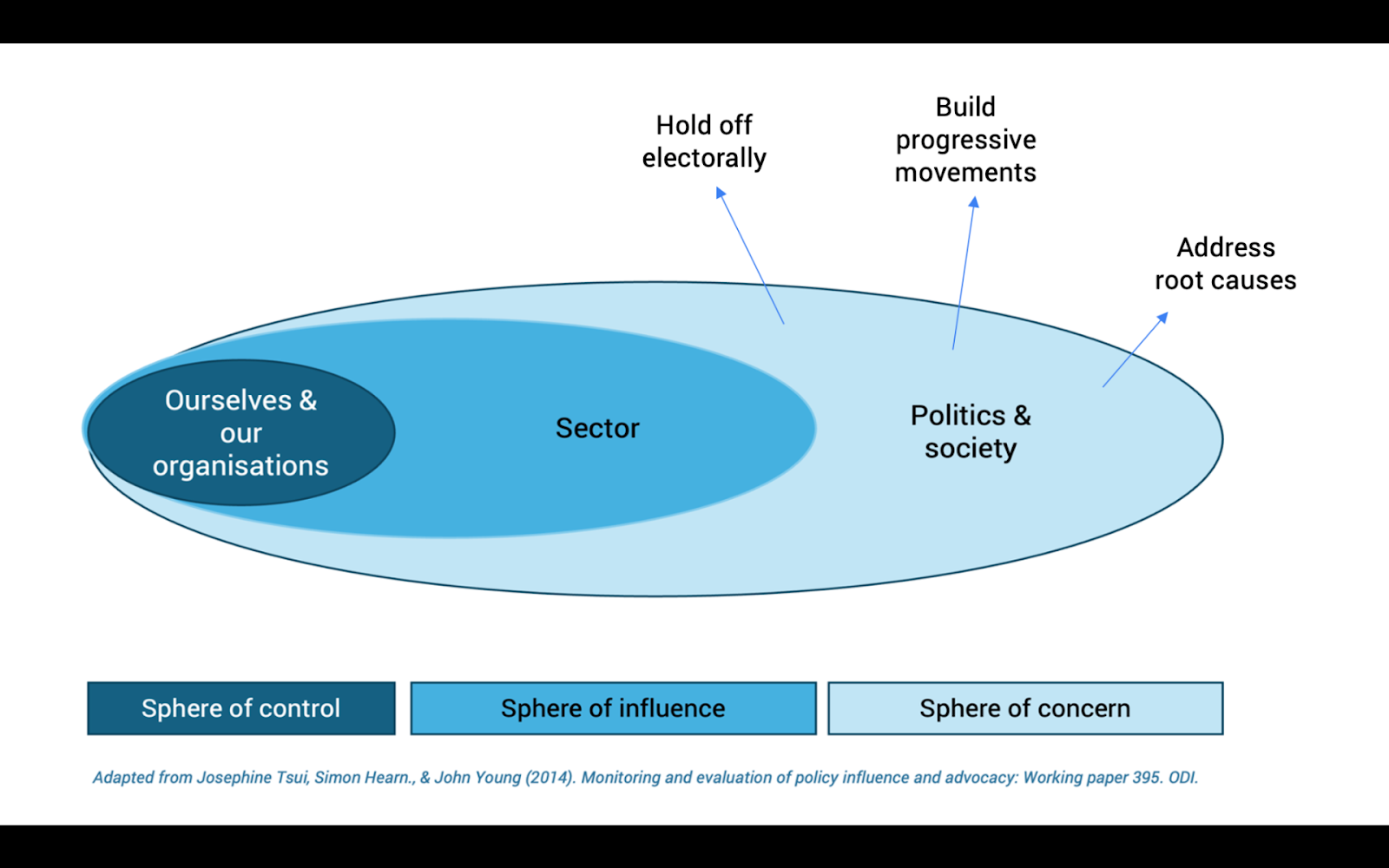
The diagram below was adapted by Jim Coe to provoke thought about what we can control and what we can influence. Our discussion explored changes needed to the social change sector in order to influence politics and wider society, acknowledging this was a sphere we had more influence on, and which we hoped could play a role in making the wider changes needed.
The way we understand the problem informs what strategic interventions might be needed
There are various levels at which ‘the problem’ can be understood and addressed. Some people are most concerned about the electoral threat from Reform, which might mean one solution appears to be bolstering the Labour party, discrediting Reform etc. A different understanding of the problem would be that Reform is a symptom of a wider hegemonic shift globally towards the authoritarian far right, whose ideas and policies are increasingly mainstreamed in UK discourse and Government. A potential solution to this articulation of the problem could be to build a stronger progressive movement to start to tackle the far right authoritarian ideas already being mainstreamed (erosion of democracy, demonisation of people migrating etc). Beyond this there’s a clear need to tackle root causes of people’s suffering and disillusionment with the political establishment, driving them to support this emergent authoritarian populism, like the cost of living crisis, widening inequality, poverty and so on.
What changes might be needed to the social change sector?
Social change work is siloed according to issue, and then divided up even further. Organisations commonly work on one aspect of one part of one issue, and although collaborative working obviously exists in myriad formal and informal ways, most energy is channeled through individual organisations working on small aspects of complex interconnected issues. On the other side, the forces pulling in an autocratic and far right direction are much more joined up, with a narrative and agenda that connect multiple issues.
We are likely to either win together, or lose together – so it makes sense to work together and connect our struggles
The kind of power needed to turn things around won’t be won by any individual issue or identity based movement – it will need many of us standing in solidarity with each other, working to defend and re-imagine democracy.
We’ve long focused on ‘policy wins’ – aiming to get legislation passed and secure policy commitments to address issues in particular ways. Indeed this is the way much of the professional ‘sector’ is structured – to develop policy proposals and advocate for them, often backed by online and sometimes in person campaign support from a wider public. Strategic litigation has also been an important tool. But as civic and democratic space is eroded, these approaches are becoming less and less effective.
The approaches considered ‘best practice’ to make change in the last few decades assume we are operating in some for of liberal democracy – and this is changing.
I have heard that many MPs aren’t holding surgeries any more or meeting their constituents (citing security concerns), which begs the question, how can they then be accountable to constituents? I’ve even heard of one MP now using an AI chat bot to answer and screen correspondence with constituents, rather than provide an email. If Reform get their way and dismantle the checks and balances on power provided by the courts, strategic litigation will no longer work. As we’ve seen in America, any positive policy progress can be torn down at speed. Securing policy wins is no longer effective, or at least, decreasingly so.
A new approach might more productively target the structures of governance itself, how laws are made, and how democratic and civic accountability is baked into decision making.
A time of transition for the NGO industrial complex
I’m seeing increasingly frequent Linked In posts declaring that the age of professionalised international NGOs is coming to an end, particularly from American colleagues. And my own research and scoping work is showing over and over again that the advocacy toolbox honed in liberal democracies over the last couple of decades is no longer working (although arguably it was only mostly achieving small concessions within a system which has been becoming more hostile causes overall). As one participant in our workshop noted:
“We are using old strategies – bringing a knife to a gun fight. How do we shift that?”
In the workshop, Jim Coe suggested we need to re-orient our work from a focus on results to a focus on resilience; from rhetorical solidarity to mutual accountability and from piecemeal responses to sustainable infrastructure and funding.
Workshop attendees ideas about what is needed:
It was easier to reach agreement on the challenges we face than the solutions. None of what was discussed was easy or obvious, but participants did have some good ideas about what new strategies might be informed by, look like and focus on, including the following:
- Technology: Addressing disinformation technology, AI & data mining – highlighting risks to corporates, governments & privacy
- Collaboration and power building: Growing networks of resistance and organising to build new forms of power is important, local to international – but this work is hard & needs investment
- Framing & storytelling: The need for intervention on these given the right is currently dictating media, political & public narratives
- Satire: Effective when directed at Reform as a party; not its voters
- Shared analysis of what the problem is (& therefore what solutions might be): Some social change organisations think they can address issues by carrying on as normal or making small tweaks; others see the need for full blown revolution
- Proposing solutions that benefit everyone: Not just specific groups, acknowledging widespread chronic injustice, & not just telling people they are bad
- Charity structures: Are they fit for purpose as they prevent political campaigning (& increasingly constrain all campaigning)?
- Resilience: Organisations may ‘hunker down’ to protect themselves, staff & funding, rather than risking pro-activity to try to turn things around
- Moving from proposing policy solutions to how policy is made: Current wins are precarious – e.g. the US no longer operates under the rule of law
- Waking the sector up to the level of threat: Scenario planning is important to get buy in from organisations about the level of threat and to adapt strategy accordingly
One overall thought was the need for some infrastructure to hold this work – there wasn’t any obvious place supporting a sectoral response to the rise of far right authoritarianism should sit. Organisations are working on siloed elements of this but no-one is holding the work as a whole.
Workshop ideas on the sector response needed
- Waking up to the urgency of the need for new strategy and a sector wide response
- Increased collaboration, cross movement and coalition working (although not necessarily through formal hierarchical structures) – to build trust, share information and enable us to adapt and move together
- Renewed emphasis on cross sector justice movements focused on building power and resilience, with participation from grassroots and small delivery focused organisations to larger campaigning NGOs and everything in between.
- More compelling narratives and more outward-facing engagement so that these narratives are actually used in conversations person to person
- Better antennae to pick on context changes and swiftly adapt
Things Jim and I can offer
Another online workshop on October 9th 10:00 – 12:00 BST exploring the new strategies we need to respond to the rise of the right. This will be similar to the one we ran back in July, adapted with learning from the first iteration. You can book tickets (charged on a sliding scale) here.
A scenario planning tool for use in social change organisations to explore the current and likely future political context and its impact on your work. You can access it here.
An invitation to ‘Building Beyond Authoritarianism’ – a growing Slack group convening people across NGOs, grassroots campaigns, political advocacy, digital and strategic communications and more worried about the rise of the right and interested in connecting and collaborating. Message me on Linked In with your email (or comment below or in a LI post if we’re not connected) for a link to join – it’s invite only.
Support to build strategic capacity (borrowing the language of the excellent Hahrie Han via Marshall Ganz). By strategic capacity we mean:
(a) ability to sense how the world is changing
(b) ways of working allowing organisations to seize opportunities and address rising challenges
(c) ability to reconfigure in response to change
Jim and I are both freelance consultants in this space – if you’d like help with this please get in touch.
We’re also exploring getting funding for a convening of convenors, starting to bring everyone involved in more siloed convenings together to talk about what kind of infrastructure needed to guide strategy in this moment.
As ever, I’d love to hear what you think about our approach and what you think is needed in this moment – or maybe you’re doing something great you’d like to share? Please comment below or via Linked In to join the conversation.
If you’ve enjoyed my writing & would like to support me to create and share more you can buy me a coffee. I share my work for the love, in the hope that its useful to strengthen movements, and that’s the biggest reward. But if you feel moved to donate something (no pressure at all) it would be gratefully received.

 thinking, doing, changing
Thanks for this piece and for offering a spot in your Slack server. I run a US-based nonprofit startup focused squarely on countering authoritarianism – it’s called Human Liberty Project.
Our first campaign is ResistTrump (www.resistrump.us) and we espouse lawful, nonviolent civil resistance and one of our core values is nonpartisanship.
LikeLike