
How is the UK social change sector responding to the rise of the far right? And what is needed? Jim Coe and I have written this report exploring these questions. The answers we propose are complicated, because the problem is multi-faceted. There is no easy fix, but we believe it is possible things can be turned around. We offer our ideas in the hope that they provide a useful framework for strategic thinking, and that our paper will support moves towards the kind of transformative collaborations we think are needed.
Our findings are summarised below, with more detail in the full report. I am starting to gauge interest in an email list and convenings around the strategic approaches we propose. If you’re interested you can sign up here.
You can also find out more at our public launch event on January 7th 2026 13:00 – 14:30 GMT.
Our call to action
-> Global power is shifting. Powerful international actors promoting authoritarianism, far right policies and ideologies are winning and their success threatens the kind of society we want.
-> The social change sector in the UK is not yet responding meaningfully to the threats this new reality poses – threats to the causes we care about and to the space in which to agitate for change.
-> We need to respond urgently, radically and in a sustained way. Our paper suggests a framework for doing this.
What did we base our analysis on?
– Conversations with around 80 people in 2 online strategy workshops
– 60+ 1:1 interviews
– Inputs from a group of freelancers working in similar areas
– Contributions of 8 leaders attending a day long convening
– Comments from 12 NGO leaders convened by Hope Not Hate
– An extensive bibliography
Heartfelt thanks to everyone who so generously contributed their experience, thoughts and time – and to our funder. We have anonymised the mapping and contributions to the report because of the sensitivity of work in this area, and the administration that would have been required to get everyone to sign off on a description of how they contributed, or what they are doing.
Scope
We focused on the social change making sector we are situated within, including NGOs, charities (which often combine service delivery and change making), other change focused not for profits, grassroots groups, and philanthropic funders. Unions and branches will be important actors and allies, as will faith groups, arts organisations, businesses and many others, but mapping and strategy in that space was beyond the scope of our (already long and ambitious) paper.
Funding
No-one commissioned this work – I started working on it because I saw the need, and Jim joined for the same reason. It has been partially funded by a donor, but much has also been done unpaid in our own (freelance) time. I am seeking further funding to disseminate the findings and to begin to build some of the relational infrastructure needed to take many of these strategies forward. Jim and I recognise we do not represent the communities and organisations most affected (although we have sought their input, including in recent interviews for my migration justice mapping). The fact that those most affected are not currently in a position to lead is a core part of the problem we identify, because those people, organisations and communities are most engaged in firefighting and have least strategic capacity.
A shout out to Hope not Hate
This is one organisation we don’t need to anonymise, because they have been working in this specific area for decades, and are well respected in the field – we have referenced their work repeatedly. They have a solid strategy supporting charitable NGOs to engage in a collective initiative to counter hate and division launching at the same time as the next mass far right mobilisation. They are also conducting invaluable research and commissioning polling to share insights and support the social change sector to respond, while also preparing a calculated, evidence-based approach to counter potential Reform electoral gains. They need resources to sustain and expand their operations, and allies to support their collaborative projects. Check them out.
What’s the problem?
I’ve explored this in depth in previous writing, but in essence:
- Reform UK are continuing to do very well in the polls – they will likely make further gains in the May 2026 local, Senedd and Holyrood elections, and could win the next general election.
- Reform is a far right, authoritarian and anti-democratic party. Their policies threaten all the causes we care about and the civic space in which change making is possible (why and how is unpacked in more detail here).
- We’re seeing a global shift towards a more far right led authoritarian capitalism, with new constellations of power relations emerging, and an international nexus of bad actors pulling the world in autocratic and far right directions. These forces are joined up and well funded (including by billionaires) promoting narratives and agendas that connect multiple issues.
- These forces are impacting politics, policies and discourse now. And its all likely to get worse, before it gets better.
The social change sector isn’t responding at the speed, scale, or ambition needed
We’re stuck in ways of operating that are no longer fit for purpose, predicated as they are on the assumption of a simpler media landscape and a liberal democracy, which is rapidly being eroded.
We’re not going to win against the far right by continuing to focus on siloed issues. For example, we’re not going to win on climate if we lose on migration (Reform is gaining power through scapegoating migrants and they are funded by the fossil fuel lobby) so organisations need to step into cross movement fights and re-orientate their strategies and practices to make this possible.
We’re already seeing how hard policy wins are to achieve using the old tools at our disposal (i.e. traditional policy, advocacy, campaigning and media work).
The entire field is already skewed against the changes we want, and anything we do win could be easily torn down by an incoming authoritarian Government.
There is also the very real danger of anticipatory compliance – the social change sector imposing restrictions upon itself well before they come from elsewhere.
The picture is bleak. And turning things around won’t be easy. But we can learn from other countries how to effectively push back on authoritarianism and far right power.
We believe it is possible if we can radically re-orientate our strategies and resources.
5 strategies we think are needed to meet the moment
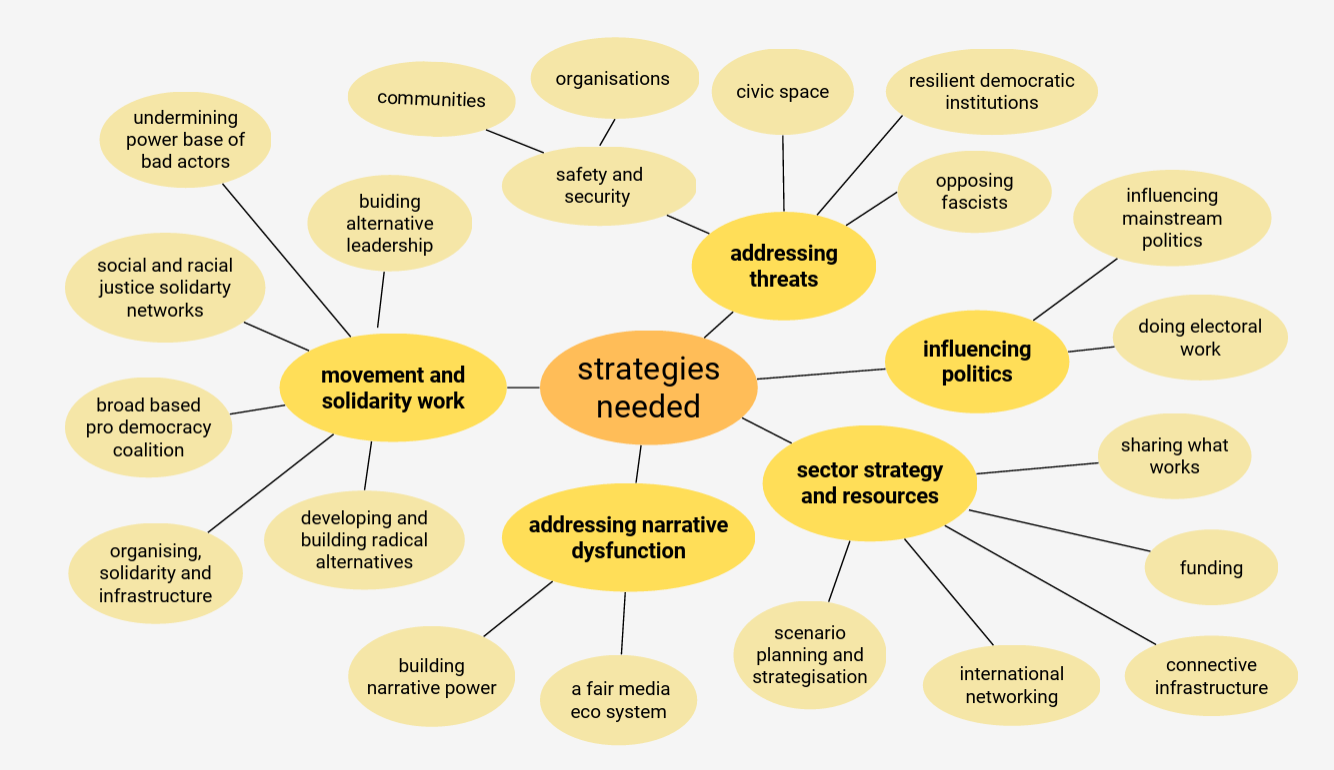
These 5 overall strategies can be subdivided further into 20 strategic approaches – further detail of which, including an anonymised summary of any UK activity we are aware of under each, can be found in the full report.
1) Investing in movement and solidarity work
This is the biggest category and encompasses a range of collaborative approaches we think are needed at scale, working across issue siloes to build and challenge power. It includes:
a) Undermining the power bases of bad actors, working across borders to expose and undermine the power and resources of the international bad actors fuelling authoritarianism around the world, through powerful campaigns and movements which oppose and disrupt them.
b) Building social & racial justice solidarity networks to connect social justice movement actors (including climate justice) in solidarity and mutually beneficial propositional activism.
c) Investing in deep organising, solidarity and infrastructure to build the power of communities to resist and have agency, along with connective tissue between them, to enable broader wielding of collective power.
d) Building a broad-based loose alliance or coalition in defence of democracy, bringing together a diverse group of actors well beyond the usual social change making suspects.
e) Building alternative leadership so that popular movement leaders are able to shape change-making strategies and wider public debates.
f) Developing and building transformative alternatives that re-imagine how society could be so that all the above can be informed by credible visionary alternatives.
2) Addressing narrative dysfunction
This is critical to tackle and overcome mis and dis-information and the toxic narratives that have taken hold, driving the shift of UK social norms to the racist, xenophobic authoritarian right. It includes:
a) Working towards a fair media ecosystem, tackling and tempering the skewed ownership and algorithms of distribution channels, and the exploitation of those channels.
b) Building narrative power to respond to harmful messages and ideologies and articulate progressive ones with the power to seed these across discourse and culture.
3) Influencing politics
This plays an important and continuing role in shaping the political, legal and democratic system we live within. It includes:
a) Influencing mainstream politics – to promote more positive policies, positions and rhetoric to the current Government and other major Parties.
b) Doing electoral work – to influence the outcomes of elections, especially in places Reform candidates are likely to win.
4) Addressing threats
This is a foundational strategy required to deliver the strategies above, so that communities, organisations and campaigners are able to withstand the grave threats they are facing, and so that growing visibility of the far right is increasingly contested. This includes:
a) Embedding safety, security and solidarity practices that support community safety, resilience and agency, through rapid action mutual aid networks of collective care, legal support and advice, building collective strength to resist growing authoritarianism.
b) Embedding safety, security and solidarity protocols and practices that allow organisations to function effectively so that organisations have the digital, communications, legal, regulatory, physical and psychosocial support they need for crisis responses and longer term resilience.
c) Protecting civic space for individuals and groups to become involved in collective political, social and cultural life, and pushing back against restrictions rapidly eroding this (such as the Lobbying Act, crackdowns on protest, the misuse of terrorism laws etc).
d) Helping build resilient democratic institutions by strengthening them, to help them withstand stress and attack by authoritarian governments, and facilitate recovery in a post-authoritarian world.
e) Robustly and visibly opposing fascists / far right so that their presence and popularity is increasingly dwarfed by the growing power of those who stand against them.
5) Re-orientating strategy and resources
This foundational work is needed to enable all of the above, by equipping organisations and groups to grapple with the enormity of the challenges and re-orientate their work to respond collectively at scale. This includes:
a) Practising better scenario planning and strategisation by ensuring the strategies, culture, processes and activities of organisations are fit to meet the moment, and to collectively respond to the volatile and increasingly challenging context they operate within.
b) Building connective infrastructure and relationships, to develop the relational infrastructure needed to hold networks of increasing collaboration and information sharing.
c) Finding out and sharing what works, drawing on a global evidence base and adding to it with UK-specific learnings.
d) Funding the work that is needed by expanding unrestricted, long-term funding from philanthropy and major donors alongside crowdfunding, membership models, and sharing of other resources (such as staff time, meeting and office spaces).
e) Building international solidarity and networking to build relationships, share learning and foster collaboration to address common international challenges.
Jim’s diagram below shows how we have grouped these strategies:
The goals these strategies serve
Adopting these strategies will enable the sector to collectively work towards common goals of:
- Building & redistributing power
- Creating a positive alternative future
- Heading off authoritarianism
- Protecting people & organisations
The foundational work to re-orientate strategy and resources is needed to create the conditions necessary to achieve them.
Theory of change
Below is Jim’s diagram shows a very simplified version of our overall theory of change, illustrating the relationship between different manifestations of the problem and the strategies we think are needed to tackle them. Again, there is much more detail in the full report for anyone interested in exploring the thinking behind the strategies we propose.

We understand that different articulations and understandings of the problem are leading social change actors to focus on different solutions. Some are still hoping to influence politics now, others are hyper focused on fighting electoral battles. While some groups are focusing on community defence against racist marches, others are working to bridge divides and organise across polarisation.
Although we identify a number of significant gaps below, more work is needed across all the strategy areas (with the possible exception of working to influence the incumbent government given that there is a lot of activity already happening in this space). Rather than suggesting we need to do x not y, we think we need to do both, and z as well. In fact, it’s almost the whole alphabet we need in play, building connections between efforts to really turn our diversity into our strength.
What we are proposing is challenging
It will require fundamental shifts to strategy, culture and structures of UK social change organisations, and new collaborations at scale.
We understand this is difficult work, especially when so many organisations are struggling for funding, already facing a hostile environment, and firefighting on many fronts.
But however hard these changes may be to implement, we think the risk of not acting is greater.
The biggest gaps identified include:
- There are no large-scale initiatives aimed at undermining and disrupting the power bases of bad actors
- Much organising infrastructure and connective tissue is missing, limiting how existing organising work is able to connect up and build broad-based power
- There is little happening to build democratic resilience and not yet an alliance forming to defend democracy (with no-one seemingly well placed to lead this work)
- There are huge gaps in efforts to ensure a fair media ecosystem, tackle the tech platforms driving polarisation and address epistemic collapse
- There is insufficient safety and security support for communities and organisations
- There is not enough work happening to visibly oppose the far right, and to channel movement energy well
- Organisations are not reorienting strategy in ways that are needed, and no-one is leading the work to build appropriate relational infrastructure for collaboration in the UK and beyond, or to share and build learnings
- Much more resourcing is needed to enable all the above
Recommendations – 5 steps for social change actors
It’s difficult to set out precise recommendations that can be applied generically, as each organisation needs to work out the best role it can play, given its understanding of the gaps, and recognising the contributions it is best placed to make.
For all organisations, what’s needed can be broken down into a set of steps to work through:
Step 1 – Get buy-in for the changes needed
Make sure people in your organisation understand the scale of the challenges faced, the implications, and the need to transformatively adapt to address these challenges. Jim’s scenario planning tool may help facilitate these discussions. Find the best ways to build sufficient agreement to be able to move things forward.
The risks of not taking transformative action now should be weighed against the possible threat of a lack of adequate response leaving the door open to an authoritarian government (which could pose an existential threat to social change organisations).
Step 2 – Protect your people, communities & organisation
Review your organisation’s safety and security protocols, and work to ensure any partners / collaborators / allies /grantees can do the same (using the resources of larger institutions to support those with less / working at the grassroots). Ensure provisions for organisations, people and communities are appropriate, to respond to existing and urgent threats and to build resilience longer term.
Step 3 – Identify the broad strategic approach that makes sense for you & resources that can support it
Work out which strategic approach makes most sense for your group or organisation (e.g. from the five we have identified, or elements within them) considering your competencies, capabilities, interests and the movement gaps. Find out more about what is already happening in the space and what more is needed to help inform and develop this thinking.
We recognise that resourcing this work is incredibly difficult at present, given other pressures and the paucity of available funding.
Funders will need to step up & can support this work by:
- Un-restricting existing grants wherever these hamper grantees’ ability to respond to the current context.
- Distributing unrestricted long-term funding in support of relevant strategic approaches quickly and at scale, for example through increasing funding to trusted existing partners or through finding new partners in open calls.
- Giving consideration to spending down or distributing assets, to resource the ecosystem at the speed and scale needed.
- Considering how and where to collaborate with other funders and to pooling funds.
- Being clear about operating as an ally in support of the people and organisations who have the legitimacy to take strategic leadership of the work, not skewing the work through accountability demands or by wielding power in other ways.
Given the scale of the challenge, it will also be necessary wherever possible to explore other options, such as new philanthropic funds, major donors, crowdfunding, and membership models.
Step 4 – Make changes needed to your strategy, structure & culture
Do what is needed internally to make strategic re-orientation possible – in terms of strategy, collaboration, flexibility, what you conceive of as success and how you will assess this. If you work in a large institution, rather than wait for the entire organisation to re-orientate before you begin, consider whether and how you can resource something external (e.g. through seconded staff capacity) or pilot / incubate something outside of your existing structure and ways of working.
Step 5 – Take an ecosystem approach to work out the detail of your strategy & role
In collaboration and relationship with others, work out the details of the best way you can contribute to what is needed, and work collaboratively to deliver it, adapting as required. The work is unlikely to be led by individual large institutions: new configurations and collaborations are needed at scale, and much of the most impactful work is likely to be led by grassroots groups, alliances and infrastructure organisations.
As part of this, NGOs can play a role in helping to resource grassroots leadership, and finding the best ways to show practical solidarity and support. This means putting resources in service of what is needed, including infrastructure and alliances, contributing to wider efforts rather than leading your own organisational campaigns.
“There is never a time in the future in which we will work out our salvation. The challenge is in the moment, the time is always now.”
James Baldwin – Nobody Knows My Name, 1961
Next steps
-> Launch event: If you would like to hear Jim and I explain our thinking and recommendations, you can join our online public launch event on January 7th 2026, 13:00 – 14:30 GMT.
-> Sharing the report further: Jim and I are also looking to disseminate findings with organisations to take this work forwards – we’re on Linked In here and here if you’d like to get in touch about this.
-> Mailing list/s and future convenings: I am working to build some new secure relational infrastructure to convene a email list for this work in general, creating additional circles and convenings around any of the strategic approaches with enough demand. I am currently working to fundraise for this project, as building the infrastructure we need will be necessary to take collaborations forwards.
-> If you’re interested in joining a general email list, one in a specific area, or might be interested in chairing a circle on any of the strategic approaches we suggest, you can express interest in that via this secure form.
As ever, I’d love to hear what you think about this? Is anything important missing? What do you think is needed in this moment – or maybe you’re doing something great you’d like to share? Please comment below or via Linked In to join the conversation
If you’ve enjoyed my writing & would like to support me to create and share more you can buy me a coffee. I share my work for the love, in the hope that its useful to strengthen movements, and that’s the biggest reward. But if you feel moved to donate something (no pressure at all) it would be gratefully received

 thinking, doing, changing
2 Comments