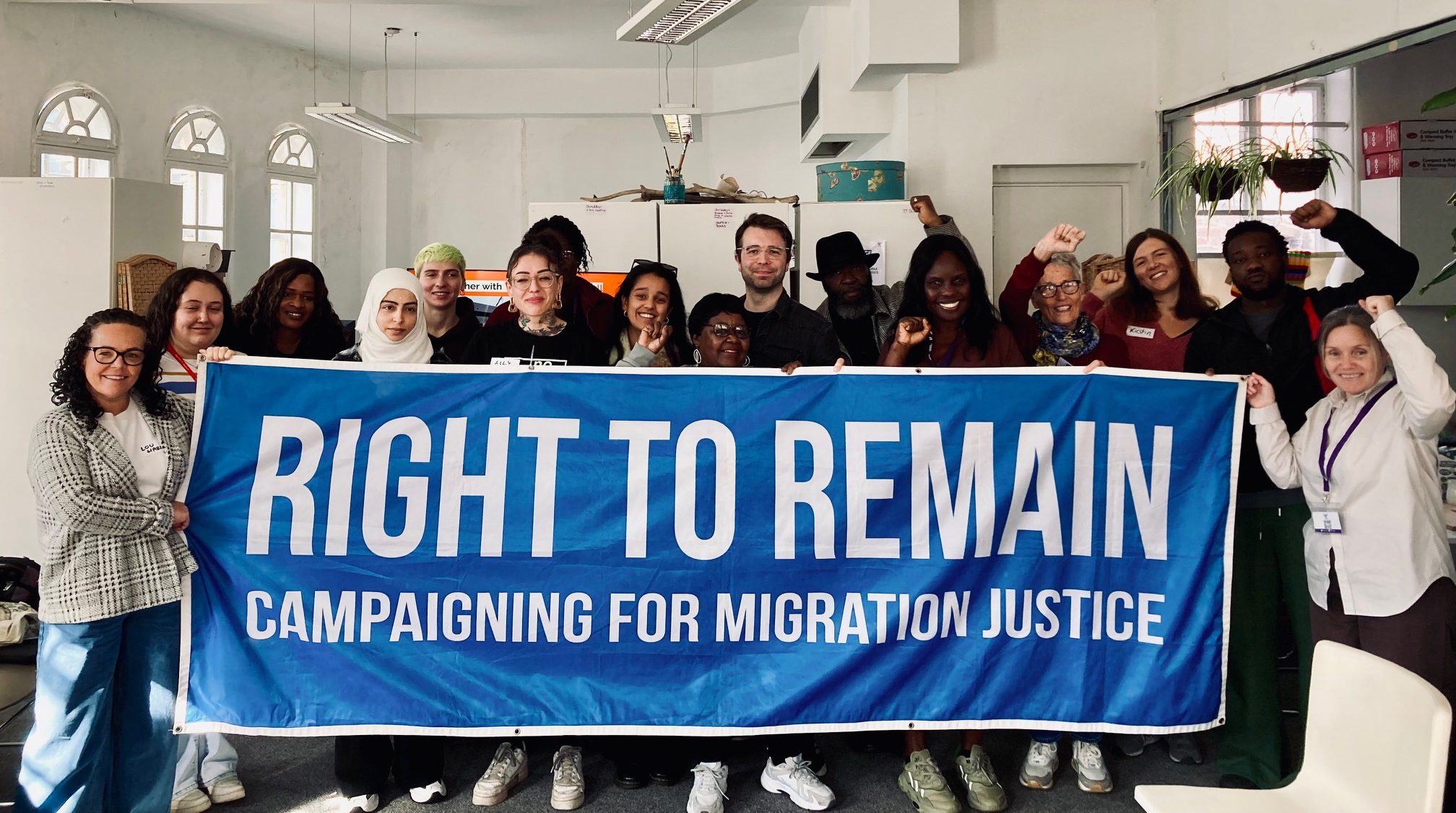
Picture above shows the solidarity session of Right to Remain in Liverpool this year
In summer 2025, in the run up to a fresh round of racist and islamophobic riots targeting hotels housing asylum seekers across the UK, I worked on a mini mapping of the migration justice movement. I conducted 12 interviews with grassroots organisers, frontline service providers, CEOs, campaigners, a funder, an academic and more to find out how they are responding to the political moment, what their biggest challenges are and what they need. Heartfelt thanks to all those who gave their time. I also did a small literature review, and a selection of interviewees fed into the final report and its recommendations.
The below is my take on the biggest headlines of this mapping and how those that want to support and stand in solidarity with the movement could respond. This work was commissioned by NEON and isn’t fully public, but I may be able to share the full report if you email me or send me a message on Linked In saying you’d like a copy.
The challenge of the current context cannot be overstated
Of course it seems obvious that with Reform leading the charge to blame all of our problems on migration, and these ideas getting increasingly normalised, it’s a very hard time to be in the migration justice movement. The weekend before writing my final draft, up to 150k marched in the Tommy Robinson led ‘Unite the Kingdom‘ far right march in London – the biggest anti- immigration demonstration in my lifetime.
Conducting these interviews really hit home for me how deeply far right authoritarian politics and organising is endangering the movement’s communities and staff, and impacting current Government policy while gaining increasing electoral power. Incredible people across the movement are working tirelessly, but despite small recent wins morale is low.
The Labour Government is delivering more of the same and has ‘closed doors’ to engagement from movement leaders. The vast majority of interviewees told me they’d never had any hope the Labour party entering Government would improve policy or practice related to migration justice, and that sadly they felt they had been proven right.
The movements’ biggest challenges
Concerns about security & safety are widespread & threats are real
Close to half of interviewees were explicit about their concern for the security, safety and wellbeing of their staff, service users and those they are supporting, campaigning and organising with. Organisations time, energy and resources are being sucked into deploying extra safety measures, reassuring and taking care of staff, managing risk and reporting threats. Given how over stretched most organisations working in this space already are, adding this stressful work is increasing the strain all round.
Attention to firefighting means movement leadership & strategy is lacking
Over a third of interviewees pointed to a lack of movement strategy and leadership because organisations are being forced to use their attention and resources to fight multiple fires, from threats to security to the constant barrage of negative press and policy proposals, and the need to secure organisations’ future income. This leaves little space for pro-activity and strategic thinking.
There’s too much attention on messaging – not enough on organising & outcomes
A quarter of interviewees were critical about the over-emphasis on crafting of strategic communications and messaging. They expressed that focus was also needed on who is delivering these messages, with a suggested move away from targeting traditional media to actually spreading messages at an interpersonal level, through organising, with some class awareness of how people actually talk. Judith Mll’s recent article on Medium articulates this well, introducing the question of the power behind narratives:
“The key question is not only what we say, but who can say it, where, and with what resources.”
There is uncertainty about what theories of change are fit to meet the moment, & a lack of preparedness for a possible Reform Government
A third of interviewees (4/12) couldn’t answer the question around what would need to change for the movement to win, although they hadn’t given up. A quarter of interviewees expressed doubt that the movement overall had an effective theory of change to meet the moment, or that it was well equipped to deliver what is needed.
While some organisations (I think rightly) see Reform coming to power as an existential threat if they achieve further electoral success, two interviewees were deeply concerned that the wider movement isn’t taking the possibility of a Reform general election win seriously. This is obviously a worst case scenario – but it seems very possible, and given the devastating impact it would have on anyone working for migrant justice, is worth both fighting against and preparing for.
There is an overall lack of collaboration & growing division
Interviewees didn’t on the whole think there were many strong multi partner collaborations or coalitions across the movement – one interviewee said there weren’t any. Everyone spoke about having very positive 1:1 relationships and collaborations with individual organisations and groups, but I heard few examples of good collaborations at scale. The movement is increasingly divided over the importance of lived experience leadership and decolonisation vs prioritising insider political strategy. Two interviewees identified a growing rift between the organisations centring anti-racist approaches and lived experience leadership, vs those that prioritise insider knowledge and more ‘pragmatic’ insider approaches focused on winning incremental concessions.
Lack of unrestricted funding
Financial needs were mentioned again and again by the majority of interviewees, who flagged the lack of sustainable core funding repeatedly as the most important challenge for organisations and the movement, the biggest thing that could help them overcome the challenges they are facing, and an important consideration in how the movement could turn things around.
Recommendations
1) Long term unrestricted funding
This was something almost universally flagged by every interviewee as something needed across the board for organisations working on migration justice. Interviewees in the workshop also suggested that some ringfenced and easily accessible funding would be useful to support organisations to cope as racist rhetoric, threats and violence rise, specifically to cover:
- costs of increased security measures and infrastructure
- health and wellbeing support, for staff and service users
2) Convening & connecting the wider migrant justice movement
Increased connection, collaboration and convening across the movement was requested by many interviewees, with a question around who would be best placed to do this. Ideally, to decrease potential power dynamics, it would not be led by large NGOs or smaller grassroots groups from inside the movement. A more neutral infrastructure organisation (such as NEON) could be well placed to lead this. Suggestions convenings could usefully focus on include:
- Strategy, reflection, learning, trust building, collaboration and joint-action, not any kind of formal coalition working, or to unite behind a specific campaign.
- Space to explore learning and collaboration around the political moment, with the potential to learn from colleagues in the USA, Hungary etc.
- Scenario planning for Reform winning more and more ground, and deepening authoritarianism, to provoke further reflection on what is needed to meet the moment (e.g. will charities be able to campaign? How can community strength best be grown?).
3) Building solidarity with other movements to develop cross issue demands
Increased convening and collaboration to build solidarity across and between other movements beyond migration could also be very useful to build power more widely. The migrant justice movement has considerable common cause with movements for racial, social, housing and climate justice, as well as movements opposing fascism and promoting democracy. It is also worth noting that other movements, like climate and housing, are under less direct attack and are therefore better placed to initiate and resource collaboration and active solidarity.
Building an even bigger tent beyond this, uniting a new movement under a pro-democracy/ anti-authoritarian banner, is likely worth exploring.
Looking at movements like No Kings in the US and We are the Firewall in Germany, they have succeeded in building mass movement pressure against the threat of the far right by uniting under a pluralistic democratic banner, framing their opposition as authoritarian and fundamentally anti-democratic. We can also learn from successful coaltions like Pacto Pela Democracia in Brazil. Such umbrella projects offer the potential for many movements to come together and build some serious oppositional power. As one workshop interviewee said:
“Rising populism and demonisation of refugees, migrants, muslims, is in political terms our biggest challenge. But we need to be careful about assuming the migrant justice movement is what will win the fight against that threat…
My political analysis is that people like Farage scapegoat migrants as means to win power in order to dismantle checks on that power to the advantage of those standing behind them.
If that is true we need to move beyond sectors and groupings and try to build strategies to build a response transcending these groups, helping to understand the risk to democracy, the rule of law and rights.”
It is not clear who might lead this at present, although infrastructure organisations could play a role.
4) Harnessing movement energy opposing the riots to build something bigger
More is needed to harness the energy opposing the far right. Stand up to Racism is the only actor currently mobilsing at any scale in this space. They organised the opposition to the ‘Unite the Kingdom’ mass far right demonstration in London, but it was only attended by around 5,000 people.
* It’s worth noting there are many risks in attending demonstrations opposing far right and fascist gatherings that need careful consideration when organising such direct resistance (I flagged some in my blog on responding to the racist UK riots last year)*
Other organisations need to form or step in to help harness this energy, building the infrastructure to engage and support people who would like to step into immediate resistance, as well as to offer ways for others not willing (or able) to engage this way, and to funnel energy into sustaining and building an opposition movement. E.g. we need to:
“Build systems for absorbing those who turn out for protests in order to channel them into multiple necessary forms of activism, including kitchen table activism, boycotts, and material aid, as well as connecting them with existing organizations with the infrastructure to support sustained engagement.”
Scot Nakagawa, The Anti-Authoritarian Playbook, From Spark to Sustained Fire
Since writing the paper I have heard good things about Black Lives Matter UK’s plans to build a bigger movement response, so that’s definitely something to watch and support.
Anti-migrant racism is what powers authoritarianism – & that affects us all – so it’s everybody’s fight
“Xenophobia isn’t a byproduct of authoritarianism – it’s the primary delivery mechanism.”
Scot Nakagawa
Far right nativist populism requires an ‘other’ to scapegoat for societal problems, to unite its base with a simple ‘us vs them’ narrative as the authoritarians position themselves as the ones needed to ‘take control’ (reducing ‘red tape’ of democratic checks and balances). The cultivation of anti-immigration feeling, and generally racism, is instrumental in the global shift towards an authoritarian far right.
But because this shift also impacts all other justice movements, all these movements (and all of us) have a powerful reason to unite to oppose it.
The migration justice movement is at the sharpest end of rising authoritarianism, and that means they’re least equipped to lead the fight against it.
We all need to step up in solidarity
NGOs (and funders) can
– Ask migration justice organisations and groups how you best can support them and follow through on what they ask for
– Make statements debunking and opposing the racist rhetoric becoming normalised, and sign onto (or coordinate yourselves) mass letters like this one
– Adapt strategy to take seriously the connected nature of migration justice and other struggles (like climate, housing, inequality and so on) and plan campaigns and other work accordingly
– Support turn out to counter protests (Friends of the Earth groups are doing some excellent work on this, so will have some learnings to share)
– Give direct unrestricted funding to groups facing the worst of the hostility, or fundraise for them
Individuals and grassroots groups can
– Find local migration justice organisations and ask how best to stand in solidarity. What do they need? What could you offer – how could you use your skills or networks to support them?
– Donate to migration justice and anti-racist organisations
– Attend counter protests (take your safety seriously – see previous article about this)
– Sign up to Black Lives Matter’s new anti-racist network
I’ve written a couple of things recently about the need for new strategies to defeat the far right and what they might look like – I’ll be sharing more writing on that soon, and I’ve started a growing slack community to share our challenges and learnings (get in touch if you’d like to join).
As ever, I’d love to hear what you think about this research – if you’re involved with migration justice, does it chime with your experience or contradict it? Is anything important missing? What do you think is needed in this moment – or maybe you’re doing something great you’d like to share? Please comment below or via Linked In to join the conversation.
If you’ve enjoyed my writing & would like to support me to create and share more you can buy me a coffee. I share my work for the love, in the hope that its useful to strengthen movements, and that’s the biggest reward. But if you feel moved to donate something (no pressure at all) it would be gratefully received.

 thinking, doing, changing
1 Comment