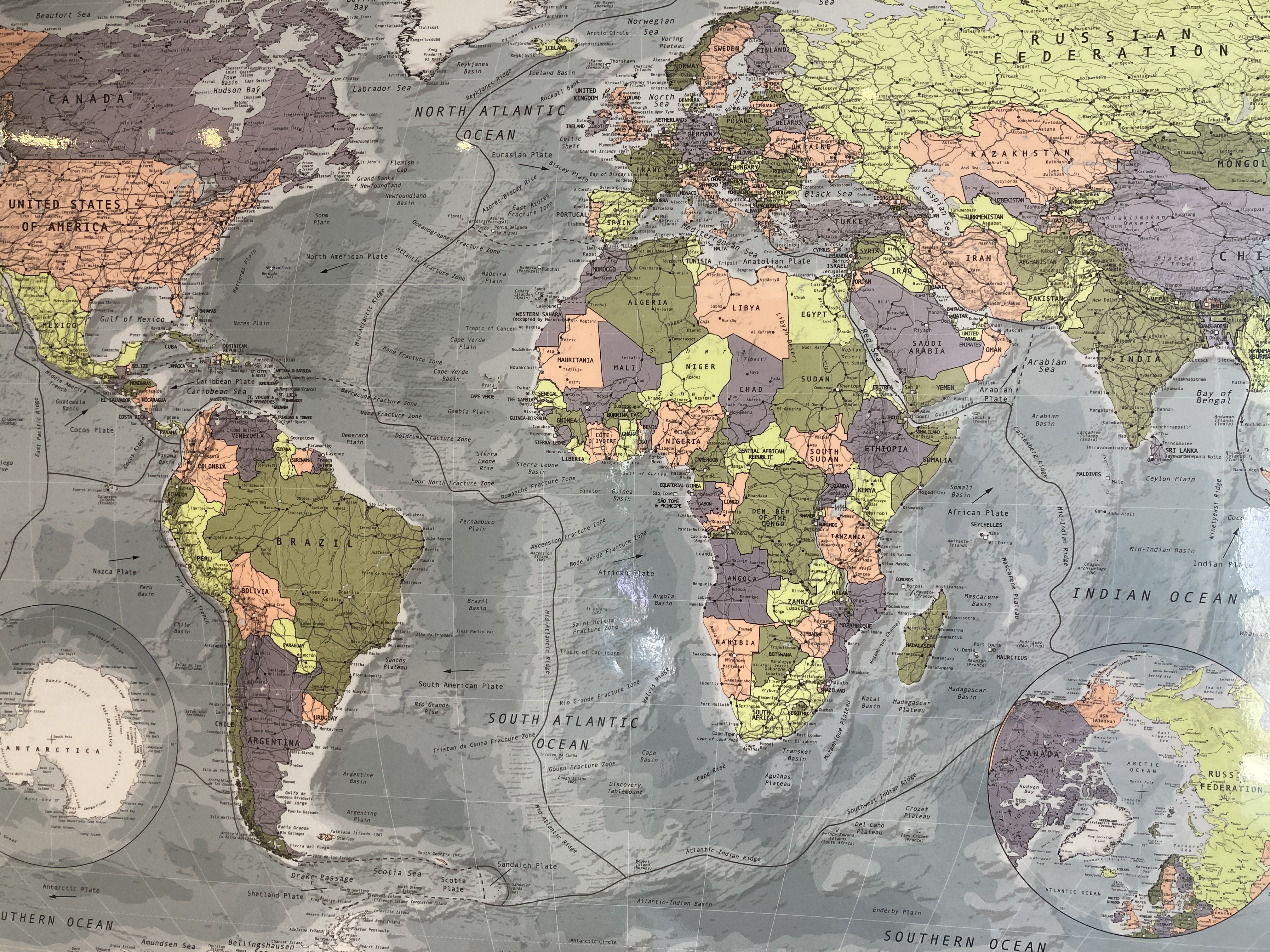
I’ve written a lot about mapping movements – in terms of theory of change, power, conflict, relationships, approach to a problem etc. But what role does geographic mapping play in movement strategy?
I’m writing to share a small piece of research exploring this. The research was commissioned by Common Knowledge, a tech Co-op which provides digital infrastructure for social movements. They wanted to understand why they get so many requests to build maps for campaigning organisations and to help them develop their open sourced Mapped platform to maximise its impact and effectiveness as a free movement infrastructure tool. This research was far from exhaustive. Alongside a short literature review I interviewed two of Common’s Knowledge’s staff and twelve people from NGOs, collectives and unions from the climate, worker and migration/anti-racist movements. Half defined at least some of their work as organising and two were focused on movement wide mapping tools (Strike Map and Local Intelligence Hub).
I’ve summarised findings below but you can download the whole paper here. Deep gratitude to all the interviewees who shared their work with me, to everyone who shared case studies and to Common Knowledge for commissioning the work.
The power of geographic mapping
The interviewees I spoke with all use geographic mapping to further their work for social justice, in myriad ways dictated by their strategy and focus, often intersecting with relational and power mapping. It makes sense, because to build power and wield this you need to be in relationship with other people, and to build those relationships you need to be in the same place at least some of the time (although digital connectivity can do a lot, it can’t replace this).
Whether you’re organising precarious workers, lobbying MPs, training activists, putting on events or protesting, all these activities happen in a particular geography. Mapping can bring together data on supporters, allies, decision makers, targets, demographics, environmental features and other place based insights, driving power building strategy. If it’s online, it can also help people find campaigns they want to support, and projects they’d like to get involved with. The research revealed that the things people would like to map far surpass what they are currently able to. Considerable impact could be unlocked through supporting movement organisations to collect and aggregate the data that would help them win campaigns, and to provide routes for them to maps this geographically.
Beware the hidden agenda of mapping tools
Reading around ‘critical’ and ‘counter’ cartography, the academic and other writing I found on map making for social change, emphasised how political the act of map making is in itself:
“Maps articulate statements that are shaped by social relations, discourses and practices, but these statements also influence them in turn. Hence, maps (and atlases) are always political.”
This is not an atlas: A Global collection of counter cartographies
The mapping tech most of us use, ‘Google maps’ for example, is not a neutral tool. It shows what the capitalist business model driving it most wants us to see – businesses that have paid for promotion, boundaries of ownership and so on. It prioritises its own algorithm – and like many of the big tech and social media platforms, has a political agenda increasingly aligning with authoritarian populism. The interviewees I spoke with were doing some paper mapping where they make their own maps, although this is more often relational and power mapping than geographic. Many were using the most freely available mapping technology – like Google maps.
Mapping & social change strategy
Below I share a few of the most significant ways I found that geographic mapping can serve social change strategy.
Fostering connections & building power
You can map your base to identify areas of strength and weakness and direct strategy accordingly – by mobilising in areas of strength, or organising to recruit more leaders in areas of weakness. You can identify where best to host events or actions, and connect people, groups and organisations to each other. For example, good use of geographic mapping can help you explore unlikely alliances – between local communities and climate activists opposing polluting infrastructure for example, or between faith groups, unions and anti-poverty campaigners all concerned about local issues which share root causes.
Online to offline
Some interviewees worked more offline, or more online, but well over half had at least some success in bringing people from email lists, e-actions and social media into real life activities, from attending events to leading actions. Several groups did this through offering information sharing events to online supporters in the form of presentations and film screenings, hoping these would politicise attendees into collective action. These activities were reported as most successful when bringing people into relationships with others in their area passionate about and/or affected by the same issues, especially where there were already active groups or at least a couple of deeply engaged people.
Targeting decision makers & demonstrating power
Democratic decision making is constituency based in the UK, from local councillors to directly elected mayors, MPs and so on. These decision makers can be influenced by their constituents. Mapping can enables connection of people to their decision makers, and helps demonstrate public support in a particular place. Although not so democratic, other local bodies can also be influenced through local pressure, from businesses to NHS Trusts. Social proof through a map, showing a campaign taking off and the strength of feeling through actions, events and supporters can be very powerful.
Crowd sourcing data & leveraging accountability
Maps can also be used to crowdsource data – from inviting uploads giving details about local land use, to reporting police harassment, bribes and corruption, there are almost endless possibilities. Where injustices are mapped and tracked, these can be made visible, along with those responsible, and accountability can be sought on a wider scale in a way more likely to attract widespread public support. Interactive maps can be a fantastic way to conduct crowd sourced research with quantitative and qualitative data, including the gathering of stories and personal testimony, to generate bodies of evidence in support of your cause.
Using data strategically
Relationships between things can be identified when layers of data are combined in reference to geographic location. The Local Intelligence Hub offers the opportunity to layer all manner of data sets, for example utilising recent public opinion polling and Government statistics. This can help to see where the public support, oppose or sit on the fence in relation to your issue, to target organising, media and communications work, and so on.
Reclaiming and redefining spaces
When maps are made through counter cartography, they can map for the first time places that are not served by commercial mapping, redefine boundaries, enable squatting, repurposing and reclamation of land. Such mapping can empower people to completely rethink what is of most importance in their area and their relationship to the land, terrain, people and organisations found there.
Mapping functionality of dreams
Connecting up relevant local groups, events and organisations
Two thirds of interviewees wanted to connect their supporters to relevant local groups, organisations, and or events, to help build and strengthen the wider movements they are part of.
“The biggest thing I want to be able to do… Imagine you’re a random person, you want to know ‘what is happening in my area?’ – seeing groups, where they meet, events they could get involved with.”
But people were also quick to raise some significant issues with this, including:
- Concerns around safety – 50% of the groups campaigning on migration and race were concerned about far right targeting of staff and communities if they were to share locations.
- Maps often don’t show the knowledge movement actors need – there are some things you can only understand by speaking to people involved in a group or in a community. The things websites and publicly available data share are not necessarily the things social movement actors would like to map and understand – so this kind of mapping can only supplement, not replace, relationship building and real conversations.
- Doing this relies on a culture of sharing – but although some organisations are happy to share events and groups and link up as much as possible, bigger NGOs especially have a track record of ‘hoarding’ data rather than sharing, although many staff inside them would prefer to share.
Identifying community meeting spaces
Over 40% of interviewees were interested in using maps to identify these, to find places to suggest for meetings and events to build deeper relationships with supporters, make new connections, provide political education on issues and spur people into action. But as above, it would be hard to get the nuance of information that could come from personal local connections and conversations in such data sets. Meeting places that seem central might look good, but be poorly used by people interested in action on a particular issue.
Plotting supporter density on a visual map
Although lots of interviewees were already plotting their own supporter density on maps, sometimes this was only done in crude ways that could be improved (e.g. through better data, like postcode) and a third said this was functionality they’d love to have and don’t already.
Gathering other geographic data sets to layer onto maps
A quarter of interviewees said they would be interested in the capacity to pull together niche / bespoke data sets to layer them on maps, with supporter density or other relevant data.
“Being able to make requests would be helpful – e.g. The Movement Research Unit has a network of people that can respond. Movement infrastructure like that would be helpful to respond to each use case and develop data for different targets.”
A few key reflections
1. Movement connective tissue is missing
People want to build solidarity, connection and power with other local people, groups and organisations. There is currently no consistent infrastructure to do this. It’s a big gap that needs addressing to meaningfully counter the rise of the right, to support communities to stand in solidarity and protect each other in the face of this threat, and to build an emergent alternative. This research echoes findings from other pieces of research, like the women’s movement mapping, which showed that although service delivery organisations were well networked locally, organisers and activists were not well connected at any level, regionally to national and UK wide.
2. Consider making your own map
Maps are not neutral – they are designed to navigate geographies according to the priorities and world view of the map maker. Actually making a map from scratch, deciding what is important with your community, can be an incredibly useful exercise. Disciplines of critical and counter cartography offer many useful tools and approaches to this.
3. Supporter and ally data collection
If you want to be able to map supporters and allies (individuals, groups and organisations) you will need to collect good data on where they are based. Asking for a postcode rather than just a city or a region will always be much more useful (although there are some circumstances where this could be risky or less desirable – see point 6 below). The better your system and process for storing and managing this data, the easier it will be to use it strategically – for example, being able to record actions taken and to pull this in a variety of ways according to the engagement of the action, being able to log individual relationships, conversations, trainings etc all could be useful (especially for organisers – and here volunteers as well as staff would benefit from across to make and pull records).
4. Connecting geographic, power and relationship mapping
It is worth exploring how the sister disciplines of power and relationship mapping can be effectively combined with geography. For example, workplace organisers can map their workplaces in relationship to the individuals that work in each part of them (down to the level of buildings), especially where leaders are located, where they move, the relationships they hold and the ones they can build. Getting people organised in communities sits at the intersection of geographic, relationship and power building.
5. Only map what makes strategic sense
Geographic mapping is not generally useful in and of itself – it’s what you use it for, how it fits your strategy, that will be important. There are many powerful ways it can be used but it could be minimally important for your campaign. It’s important to start with what you want to achieve and to make plans backwards from there, determining what you think is needed to achieve each necessary step in pursuit of your goal.
6. Gathering and layering relevant data
The data that best serve your strategy will vary according to what that is – supporters and allies, geographic features, locations of decision makers, NHS trusts, target corporate head offices or factories, types of land use, event spaces, opinion polling and so on. Work out what you need to know, or look at what you already know and see how you could best augment that.
7. Surveillance, data protection and safety
I’m not an expert on this but of course it’s important to be data protection and GDPR compliant when handling people’s personal data. In the context of shrinking civic space and increasing surveillance, harassment and imprisonment of activists in the UK, it’s also very important to think about online safety and potential surveillance. Uploading data to google maps or using unencrypted messaging may not be a good idea. And of course many working on issues like migration are rightly concerned about safety (from the far right and the state) which will restrict how much publicly available data (if any) you want to share about any person, group or organisation’s location.
If you’ve enjoyed my writing & would like to support me to create and share more you can buy me a coffee. I share my work for the love, in the hope that its useful to strengthen movements, and that’s the biggest reward. But if you feel moved to donate something (no pressure at all) it would be gratefully received.

 thinking, doing, changing