
I revisited the climate movement to see what had changed since I first mapped it back in late 2021. This is a smaller piece of work, more a movement ‘stocktake’ – exploring what might be possible to collaborate around and win in the current political context. A lot has changed and is still changing fast – not in a good way. I spoke with 17 people and gathered their anonymised feedback into a report. Those I spoke with included people from big NGOs, direct action groups, coalition and convening organisations (including those representing the nations), think tanks and a funder amongst others. The work was commissioned by Green Alliance, intended as a movement resource, and they alongside my other interviewees had an opportunity to feed into the draft.
The below is my take on the biggest headlines of this mapping and how the climate movement could respond. But there’s more in the full report – please email me or send me a message on Linked In if you’d like a copy.
Comparing 2021 & 2025 mappings
Interviews for the first mapping were largely conducted just ahead of COP 26 in Glasgow, when
the movement was enjoying peak public support, still riding high on the 2019 School Strikes for Climate and XR momentum. The context, and the mood of interviews, is now quite different. The transition is further along, the authoritarian right has gained significant global ground, we’ve been witnessing the devastating genocide waged on Palestinians in Gaza (which has understandably become a big movement focus for many previously organising on climate), and people are faced with a cost of living crisis that deepens by the day.
This time I didn’t explore movement boundaries or the difference between the climate justice, climate and environmental movements. But there was less of an internationally facing focus to interviews, with climate justice discussions being largely focused on a just domestic energy transition, and few references to any kind of international climate justice or climate finance. The transition is now firmly at the forefront of discussions, and conflict is still rife.
Everything is rapidly shifting to the right
I conducted interviews between December 2024 to March 2025. To begin with, people were much more optimistic about Labour’s climate policy and what could be won. But as they introduced a narrative of ‘green versus growth’ (seemingly responding to Reform UK’s attacks on net zero), labelling the environmental movement ‘eco zealots’, signaling approval of new airport runways, threatening cuts to GB Energy and slashing the aid budget (etc) – the mood became much more pessimistic.
During this time we’ve seen the populist authoritarian right continue its global ascendancy, most notably with Donald Trump coming to power in the United States. And of course Reform UK won sweeping victories in the recent English local elections, with a strong ground game and considerable momentum as they set their sights on the Senedd, Holyrood and Westminster. In some of my other internationally facing work I’m seeing that this reflects a global hegemonic shift from neoliberalism towards a more rightwing authoritarian capitalism.
This leaves UK Labour increasingly isolated as a centre/left Government on the global stage, putting them under extreme pressure. I have some sympathy that given the hole in public finances they have challenging trade offs to navigate in order to finance public spending. And their environmental policy remains relatively ambitious – on publicly owned energy, decarbonisation targets, nationalising the railways, and warm homes.
But as interviewees reflected, people do not feel the Labour Government is currently delivering any actual or hope of improvements to their lives while the cost of living crisis continues to bite. Instead, the Government is lurching to the right, most recently with Starmer’s speech on immigration using the phrase ‘island of strangers’ right out of Enoch Powell’s infamous ‘Rivers of Blood’ speech. In my opinion, all this is doing is shifting the Overton window further right and normalising Reform’s far right agenda. I can’t see how change (in any good and meaningful way) is going to come from Westminster.
A lack of hope & the need for new strategy?
It’s hard to be in the climate movement right now. People no longer feel Labour is inherently onside. The transition is here, and in the short term it is expensive. If it seriously impacts jobs and people’s pockets the UK public will increasingly reject net zero. Compared to my previous mapping, the focus has shifted away from international leadership and justice to domestic delivery.
Things are bad, and many current strategies are not making progress on the changes we need. This isn’t surprising given that strategies to change were developed in different political times, and given the seismic political shifts we’re seeing.
35% of interviewees don’t think the climate movement can win without making big changes. Some felt this change would need to come from conditions outside the movement itself, whereas others were more optimistic and thought the movement could re-align itself to win. ⅓ of interviewees want to see the climate movement being bolder and taking more risks.
“What are you waiting for? When do you take a risk? If not a year like this how dire do things have to get before we do things differently?”
The climate movement isn’t powerful now – but has the ingredients to build & wield its power
Power is dynamic and exercised in relationship. It’s not a fixed thing you have or don’t have – you exercise it in relation to other people and resources. While the climate movement isn’t currently feeling its power, it has many of the raw ingredients necessary for success. It is extremely well resourced and well connected across itself, has strong institutions, a wealth of expertise, and is seeing increased investment in organising. The current seismic political shifts we’re seeing represent a significant opportunity to do things differently, and build and wield the power needed to turn things around.
“In order to wield power you need to build power.”
Movement actors need to work out how and when they can best strategically build and wield their power, bolstering insider influencing with this, disrupting in ways that court public support rather than polarise against it where possible. There are careful calls to make around when to put energy into a serious disruption threat to force the Government to concede versus when it’s better to address blockers in public opinion to pave the way for the Government to act. It’s also worth noting that relative to other UK social movements the climate movement is in a strong position.
Current approaches include a lot of influencing, organising and convening
While it wasn’t possible in just 17 interviews to interrogate theories of change in any detail (hence
suggestion about follow up work exploring this below), 41% of interviewees said they were pursuing ‘inside track’ tactics, with the same number engaging in convening work, and organising. But the organising (meaning approaches to build people’s power, agency and strategic capacity to act collectively) was not necessarily central to strategy – in many cases pilot or peripheral which makes it quite fragile and limited.
From the previous 2021 mapping, this represents a continuation of the trend to organise and also a swing towards a much more insider influencing approach, likely connected to the relative increased access to the new Labour Government. Unlike the previous mapping, there’s relatively little mass mobilisation or engagement. The power of funders to direct the movement, often in problematic ways, was mentioned again. I heard similar complaints to those leveled in the previous mapping including a lack of accountability to the movement, and a short term approach to funders’ own strategy which is viewed by some as not radical enough.
People are rightly worried about the rise of the right but don’t yet have a plan to respond
With Reform dragging politics to the right and posing an increasingly serious electoral threat, people are very worried about the rise of the far right. Almost all interviewees expressed some concern and 41% of interviewees were explicit about taking the rise of the right very seriously. But thinking around this problem is at an early stage. On the flip side there is an opportunity to build a powerful alliance between the climate and anti-fascist movements, as these agendas now directly align.
How to pay for the transition?
The need to pay for the transition to renewables is where Reform’s anti-net zero rhetoric is getting purchase, so the climate movement clearly needs an answer to this. Interviewees told me that high interest rates make previous calls to increase borrowing more challenging, despite long term savings the transition could net. The most popular suggestion from interviewees on how to fund it was through some form of tax on polluters / the super rich.
What does winning mean?
Of course any win is relative (with climate tipping points looming), but hardly any interviewees spoke about this. 23% of interviewees said they did think the climate movement could win. But interviewees defined winning variously as getting to the next election with Paris goals intact and not too much backsliding; a strong public mandate supporting climate action; the green transition not coming out of people’s pockets and the end of the fossil fuel industry.
“Yes, I wouldn’t be doing this job if I didn’t think we could win. The job is to create conditions for change.”
One interviewee argued that the climate justice imperative to work for a win should override any
reservations the movement might have about victory being possible, and suggested a need for centering “stubborn optimism”.
“People in the Maldives don’t have time for the UK climate movement to think it’s unwinnable – that’s a luxury.”
Opportunities, gaps & potential next steps
From all I heard, these are my suggestions about where the climate movement could usefully focus. But they’re far from exhaustive and I would love to hear your thoughts too – please share in the comments below.
1) Understanding movement theories of change
This research wasn’t able to dig deeply into the current challenges and how different organisations’ and groups’ theories of change respond to them – because of limited time, a lack of collective thinking space, and also because many organisations are still in relatively early stages of working out how to adapt.
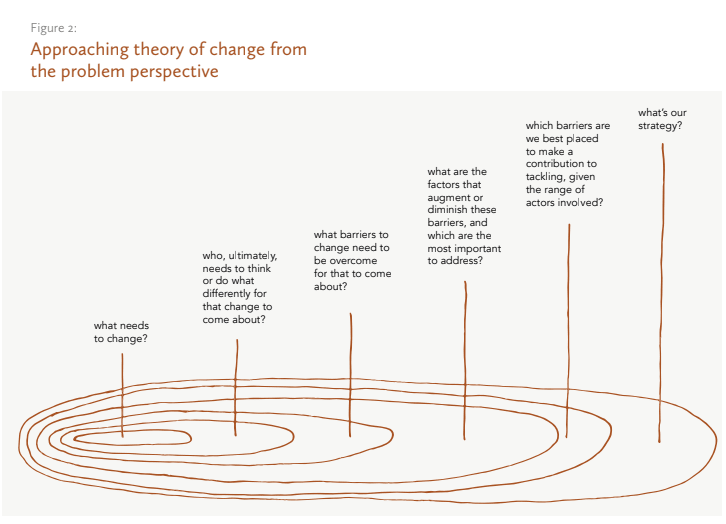
The best way I’ve found to check whether or not all routes to solve the problem you’re working on are being deployed across a movement is to develop a problem centred theory of change (as depicted above, proposed by Jim Coe and Rhonda Schlangen in their advocacy evaluation paper ‘No Royal Road‘). You begin in the centre of a series of concentric circles with what needs to change, then consider who or what needs to do things differently to make that change, what the barriers are to that happening, and what could augment or diminish these barriers. Then you’re in a position to map which organisations are working to tackle which barriers, and identify any gaps or areas of weakness in which different actors may feel they are best placed to intervene.
I suggest a workshop to do this with a selection of people across the climate movement would really help to orient strategy collectively, spreading the tactics and approaches across a range of actors. If anyone is interested in supporting or convening this please get in touch.
2) Building & wielding power to prioritise the climate agenda
Power is not a fixed quality, but a dynamic relationship between players. The climate movement feels weak but it is not weak in any fundamental sense. There are many ways it can effectively wield the power it already has and to grow this further.
a) Demonstrating and increasing the salience of climate action is likely to have an impact on
Labour’s electoral calculus. Work is needed to understand where public opinion is at, how much of
an impact Reform is having eroding it, and to demonstrate that support strategically. This could be useful both from Labour’s traditional left leaning base and from unusual
suspects from the limited demographics Labour is currently playing to.
b) Showing the support that exists will also be important. Ideally in strategic moments, and with
growing support from outside the movement, mass mobilisations will be needed.
c) Organising to build public support, to listen to what people care about and to ensure the climate movement is working to meet people’s needs is fundamental. This is happening to some extent but it needs to be much more central, not through pilot projects, and for power to be flowing down to those communities, not up to funders, boards and senior staff.
d) Leveraging the power of the Labour party and the movement’s connections to its decision makers will also be important. Whilst access shouldn’t be confused with influence, it can be leveraged for influence, for example by supporting blocks of MPs to move collectively and stand up for the climate agenda. Many new MPs and backbenchers could be recruited to rebel publicly or quietly.
3) How to fund the transition – a wealth and or pollution tax?
Since the overriding concern with the transition is who will pay for it, with Reform framing it as something ‘being imposed on ordinary people’ at their expense, the movement needs to answer this. Some are already campaigning for a polluter or wealth tax, and some kind of windfall tax on energy firm profits / taxing the extremely rich would be an easy sell for the public. This seems a promising idea to explore building truly mass pressure around, and is something that movements beyond climate would also likely support. It would require some dynamism from the movement in taking confidence to set the agenda, and also some delicacy in wading into a space where others are already working and potential tensions around where such money should be spent.
4) Uniting the climate & anti-fascist movements
In this moment there is the potential to build a powerful environmental and anti-fascist coalition to oppose the far right. One way of doing this is to respond to Reform’s electoral ground game in kind. Hope Not Hate have produced some excellent insights into Reform including polling identifying the very different groupings making up Reform’s growing supporter base, some of whom are positive about climate and many of which could be engaged by the movement and wider movements on the issues that concern them most.
There is also a need to tackle Reform online and their strong digital game, and it may be worth considering developing a more coherent joined up narrative on the left about the root causes of problems and how they relate to each other. This work could benefit from some collective strategy and leadership, including and beyond the offers of Hope Not Hate.
5) Getting out of the London bubble
Central climate movement efforts are, frustratingly, still mostly focused on London and the bigger English cities. We need to be organising in and with people in small towns, rural and post industrial areas, as well as in the nations. There are significant threats from Reform / opportunities for work in the Senedd and Holyrood elections next year, and the organisations working in these spaces can support work around this if the movement is able to resource them to do so.
6) Adapting strategic communications
Reform, and far right messaging and comms are getting traction in print media and online. I heard a few great suggestions about areas the climate movement would do well to consider to counter their culture war.
a) Engaging with a culture war being waged through commodification of attention
Since the culture war centres commodified attention, how can the climate movement identify what it needs people and politicians to pay attention to, and make sure they are? Thought around disinformation, and a solid online strategy is needed here.
b) Countering Labour tactics of multiple anti-climate announcements trailed in the news for weeks
We’ve all heard the Trump administration’s rapid fire barrage of policy described as flooding the zone as it came into office. The Labour parties’ announcements rolling back the climate agenda have a milder feel to them but have also felt relentless, leaving movement actors struggling to know where to respond. On top of this, announcements have been leaked, rumoured and trailed weeks before they are confirmed, meaning that by the time something is a formal policy it is old news. Since Starmer and Reeves were doing this every time (during climate problematic policy announcements made at the time of interviews) , the climate movement needs to get quicker at responding and to work out how best to do this.
c) Weaving a joined up narrative
Reform are good at hitting a range of talking points when addressing any issue, weaving together a narrative which clearly identifies the causes of problems and positions their policies as the solution. The climate movement often talks about facts rather than systems, and doesn’t paint a convincing picture of the more beautiful future it is working to create. The movement could benefit from greater reflection on the stories it tells, and who is telling them, to grow support for the climate agenda
7) Celebrating the wins
The climate movement is in a relatively good position compared to other UK social movements. The challenge is overwhelming and existential, but the truth of a victory isn’t as binary (win or lose) as it appears. Although we’re likely headed for runaway climate change, every bit of progress will slow and temper that. The movement has much to celebrate. Given the situation it is understandable that it doesn’t feel enough. But much less progress is likely if people feel hopeless. At the same time it is important to recognise the scale of challenge and the way we feel about it…
8) Re-centring collective care
Working on climate is a lot. There’s no getting around how bleak the reality is. We’re on track for a
temperature rise likely to trigger tipping points creating feedback loops which will generate more warming, there’s a biodiversity crisis, the poorest and least responsible people are already facing the worst effects of the crisis and things are set to get worse. Working on this generates some pretty big emotions and vicarious trauma. The movement would benefit from making space for grief and acknowledging the pain of where we are to support people to avoid burnout, stay engaged, and find the positive. If people continually jump to the positive without acknowledging the losses and all the emotion associated with that, it’s just not sustainable.
9) Relationships are strategy & worthy of investment, especially beyond the movement
There is a significant amount of work being done around movement building, and a wealth of
organisations supporting collective action, discussion and meaning making (from outside game convenings to the work of the Climate Coalition, NEON, Green Alliance’s Project Boost, Stop Climate Chaos Scotland and Climate Cymru). That’s to be celebrated and will certainly be making an impact on building relationships. But the movement is relatively insular and would benefit from reaching out into partnership beyond itself, and also beyond trade unions which in interviews seemed standing in for ‘wider public’ engagement. Relationships with trade unions are of course immensely valuable, but they’re not the only institutions through which the movement can engage people.
I also wanted to emphasise that personal (not organisational) relationships are strategy, as they facilitate not just information flows but also personal understanding of different perspectives which is made possible through relational commitment. It’s important to disagree well and listen to each other when we do, and that needs a base level of trust and goodwill that often only comes from a personal relationship. If the movement is to succeed in raising the salience of climate with the public, efforts to cultivate relationships across difference should continue to be made inside the movement but especially beyond it.
10) Is more systemic change necessary / possible?
For a final reflection, following a question in the interviewee roundtable (discussing the first draft of this report) about whether or not anyone had spoken about alternatives to ‘growth’ (they hadn’t), I realised that this research is framed as exploring the possibility of meaningful incremental change within the current system. In other words, it assumes that sufficient change is possible within the current economic and political system, or that this is the only credible approach.
I wanted to highlight that assumption and pose some questions. Can the climate movement ‘win’ enough within the system as is, oriented towards perpetual economic growth, and increasingly steered by the authoritarian right? If not, what might a theory of change look like that moves towards changing this system? For example, is it possible for the climate movement to work towards ‘non-reformist’ reforms; incremental wins that each build the power of the movement, placing it in a position from which a bigger win might be possible? And if that is possible, what might it look like?
No easy answers
These are the sorts of questions I think people in the climate movement, and honestly all movements, should be asking. If the current system is in fact causing all the problems we are working to tackle, how do we change it, and what do we replace it with? There are no easy answers but I don’t think there’s been a more important time in the couple of decades I’ve been working on social change to ask these questions.
As well as systemic change, I think we also need to focus on defence and solidarity. In the UK the cost of living crisis is having a devastating impact on many people’s ability to meet their and their families basic needs, racist hatred and violence is on the rise, trans people are under attack. We need to take care of each other amidst what is already here and what is coming, as well as imagine something new and build it.
I know this all sounds a bit bleak, but I think it’s important to face the reality of what is happening as much as we can without getting overwhelmed. I’m noticing a tendency in myself and others to either ignore it or to get totally overwhelmed, and to bounce back and forth between these two poles, neither of which are helpful. We need to do what we can to take care of ourselves (finding steady ground is helpful on this), so that at least some of the time we can sit in the middle, looking squarely at what is happening, and working creatively with that. As long as there is creative possibility there is hope. Will be sharing more thoughts on the rise of the right and what a creative response could look like soon…
If you’ve enjoyed my writing & would like to support me to create and share more you can buy me a coffee. I share my work for the love, in the hope that its useful to strengthen movements, and that’s the biggest reward. But if you feel moved to donate something (no pressure at all) it would be gratefully received.

 thinking, doing, changing